
Sauna Parts You Should Know: Heaters, Stones, Panels & Controls
Most people research which sauna to buy without understanding what's actually inside it. The heater type, stone quality, wood species, and control system determine how your sauna performs, how long it lasts, and how good it feels every single session. This guide breaks down every major component so you can evaluate what you are actually buying — not just what it looks like in a photo.
What You Need to Know
The heater is the most important component — it determines heat quality, efficiency, and longevity. For infrared saunas, carbon fiber panels outperform ceramic for even heat distribution and far-infrared output. For traditional saunas, electric heaters from HUUM or Harvia are the benchmark for consistent, durable performance. Wood species, control systems, and stone quality each meaningfully affect the experience — and knowing what to look for prevents expensive mistakes.

Understanding what goes into a sauna — from the heater type to the wood species to the control system — is the difference between buying confidently and buying blind.
Sauna Heaters: The Most Important Component
The heater is the heart of any sauna. Everything else — the wood, the controls, the accessories — supports the heater. Getting the heater wrong means the rest of the sauna underperforms regardless of quality. There are three main categories: infrared heating elements (for infrared saunas), electric resistance heaters (for traditional Finnish saunas), and wood-burning heaters (for outdoor and off-grid setups).
Infrared Heaters: Carbon Fiber vs Ceramic
If you are comparing infrared saunas, the single most important specification is the heating element type. The two technologies produce meaningfully different experiences and long-term performance.
| Factor | Carbon Fiber Panels | Ceramic Rods / Tubes |
|---|---|---|
| Heat Distribution | Even, full-panel surface area | Concentrated around rod — uneven |
| Wavelength Output | Primarily far-infrared (8–12 microns) | Mid-infrared — less deep tissue penetration |
| Surface Temperature | Lower (130–150°F) — safe to touch briefly | Higher — burn risk at close proximity |
| Heat-Up Time | 10–15 minutes | 15–25 minutes |
| Durability | No moving parts, very long lifespan | Fragile — cracks under repeated thermal stress |
| Energy Efficiency | Higher — large surface area requires less wattage | Lower — concentrated heat is less efficient |
| Found In | Higher-quality infrared saunas | Entry-level and mid-range infrared saunas |
Full-Spectrum Infrared: Adding Near and Mid-Infrared
Some premium infrared saunas offer full-spectrum heating — combining near-infrared (NIR), mid-infrared (MIR), and far-infrared (FIR) in a single unit. Each wavelength penetrates tissue at a different depth and produces slightly different effects:
- Near-infrared (0.76–1.4 microns): Penetrates shallowest — supports skin rejuvenation, wound healing, and cellular repair at the surface level
- Mid-infrared (1.4–3 microns): Reaches muscle tissue — effective for pain relief and circulation improvement
- Far-infrared (3–1000 microns): Deepest penetration — the primary driver of the core temperature elevation, detoxification, and cardiovascular benefits associated with infrared sauna use
Full-spectrum units are worth the premium for users who want to maximize the therapeutic range of their sauna — particularly for skin health, deep tissue recovery, and the full hormetic stress response that drives cardiovascular adaptation.
Electric Resistance Heaters for Traditional Saunas
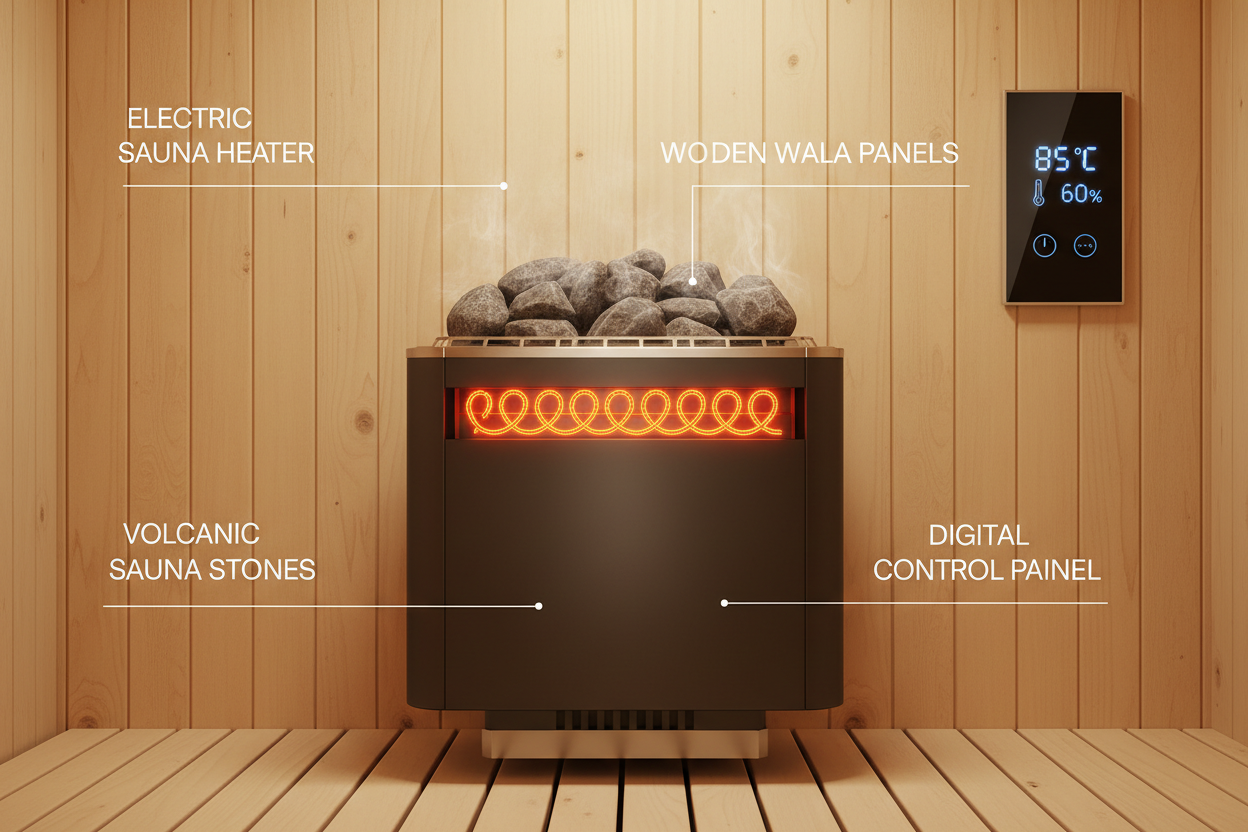
Traditional Finnish saunas use electric resistance heaters — essentially a heating element surrounded by sauna stones. The element heats the stones, and the stones radiate heat into the room while also holding thermal mass for steam production (löyly) when water is poured over them.
Heater sizing is straightforward: 1 kilowatt per 45 cubic feet of sauna volume is the standard rule. A 6x8x7 foot sauna (336 cubic feet) needs approximately 7–8 kW. Undersizing the heater means the sauna takes too long to reach temperature and struggles to maintain it during use. Oversizing wastes energy and can over-stress the heater element.
HUUM and Harvia — The Benchmark Brands: Both are Finnish-engineered and represent the standard for residential electric sauna heaters. HUUM heaters are known for their sculptural design and exceptional stone load capacity — the HUUM DROP can hold up to 55 lbs of stones for superior steam quality. Harvia heaters have a decades-long track record of reliability in both residential and commercial installations. Both require 240V dedicated circuits and professional installation.
Wood-Burning Heaters
Wood-burning sauna heaters — called kiuas in Finnish — are the traditional choice for outdoor barrel saunas and off-grid setups. They produce a distinctive type of heat that many experienced sauna users prefer: more radiant, less convective, with a sensory quality that electric heaters do not fully replicate. The process of building and tending the fire is itself part of the ritual for many users.
The trade-off is practicality: wood-burning heaters require a chimney installation, a wood supply, and 45–90 minutes of fire preparation before your session. They are not appropriate for indoor residential use without proper ventilation and building code compliance. For outdoor setups where the ritual matters as much as the convenience, they are exceptional.
Sauna Stones: Why They Matter More Than You Think
Sauna stones are not decorative — they are functional components that directly affect the quality of your heat and steam. The right stones hold thermal mass effectively, release steam evenly when water is poured over them, and survive the repeated thermal shock of heating and cooling without cracking or crumbling. The wrong stones degrade quickly, produce poor steam, and can release dust or mineral particles into the sauna air.
The Best Stone Types for Sauna Use
Not all rocks are suitable for sauna use. The repeated cycle of extreme heat (up to 600°F at the stone surface) followed by sudden contact with cold water creates significant thermal stress. Stones must be dense, non-porous, and geologically stable to survive this cycle over years of use.
| Stone Type | Heat Retention | Steam Quality | Durability | Notes |
|---|---|---|---|---|
| Olivine (Dunite) | Excellent | Excellent | Very high | The gold standard — used in Finnish saunas for generations. Dense, non-porous, stable. |
| Vulcanite / Diabase | Very good | Very good | High | Common in quality residential heaters. Excellent thermal stability. |
| Granite | Good | Good | Moderate | Widely available but can crack under repeated thermal shock — inspect regularly. |
| River stones | Variable | Poor | Low | Avoid — inconsistent density and composition, high cracking rate. |
| Lava rocks | Moderate | Moderate | Moderate | Porous — absorb minerals from water over time, degrade faster than igneous stone. |
How Much Stone Do You Need?
The stone load directly affects steam quality and thermal mass. More stone means more heat stored, more steam capacity when water is poured, and a more stable temperature during your session. Most residential electric heaters call for 40–60 lbs of stones as the manufacturer-specified load. Do not under-load — a sparsely stoned heater produces weak, inconsistent steam and overworks the heating element.
When to Replace Your Sauna Stones
Sauna stones degrade over time. The signs that stones need replacing include visible cracking or flaking, a gritty residue appearing in the stone bed, steam that smells mineral or burnt, or stones that have visibly broken apart. For regular residential use (3–5 sessions per week), plan to inspect stones annually and replace the full load every 3–5 years depending on stone quality and usage intensity.
Sauna Stone Maintenance Checklist
- Inspect stones annually — remove and check each stone for cracks or crumbling
- Use only pure water when pouring löyly — mineral-rich water accelerates stone degradation
- Allow heater to cool completely before removing or rearranging stones
- Replace stones that show visible cracking, fractures, or surface spalling
- Replace the full load every 3–5 years for heavy residential use
- Never use river stones, painted stones, or stones of unknown composition
Sauna Wood: Species, Quality, and What to Look For
The wood used in a sauna affects the experience in ways that go beyond aesthetics. It determines how the sauna heats, how it feels against your skin, how it holds up to years of heat and humidity cycling, and whether it off-gasses anything unpleasant during your sessions. Most people spend little time evaluating wood species when comparing saunas — and most regret it when a cheap wood sauna starts warping, cracking, or developing mold within a few years.
The Main Wood Species and Their Properties
| Wood Species | Heat Resistance | Durability | Feel / Texture | Best For |
|---|---|---|---|---|
| Western Red Cedar | Excellent | Very high | Smooth, warm — low splinter risk | Premium indoor and outdoor saunas |
| Nordic Spruce (White Spruce) | Good | Good | Light, smooth — slightly more resinous | Traditional Finnish saunas, outdoor units |
| Hemlock | Good | Good | Very smooth, pale — low odor | Users sensitive to cedar scent, indoor saunas |
| Basswood | Good | Moderate | Very smooth — virtually no odor | Allergy-sensitive users, infrared saunas |
| Aspen | Good | Moderate | Soft, light — minimal odor | Budget-friendly, light-use indoor saunas |
Western red cedar is the benchmark — it is naturally antimicrobial, highly resistant to warping and cracking under repeated heat and humidity cycling, produces a pleasant natural scent during sessions, and feels comfortable against bare skin even at high temperatures. Nordic spruce is the traditional Finnish choice and performs comparably in outdoor environments. Hemlock and basswood are good alternatives for users who are sensitive to cedar's scent or have wood allergies.
Construction Quality Indicators
Beyond wood species, evaluate how the sauna is constructed. Look for tongue-and-groove paneling (not flat-panel boards that can gap and warp), pre-cut kiln-dried lumber (reduces warping after assembly), and double-wall construction for better heat retention and energy efficiency. Benches should be thick enough to resist warping — 1.5 inches minimum for seats, 2 inches preferred for the main bench surface.
Sauna Controls: Analog, Digital, and WiFi
The control system determines how you interact with your sauna on a daily basis — and it affects whether you actually use it consistently. A control system that is unintuitive, unreliable, or slow to respond adds friction to a practice where friction is the enemy of habit.
Analog Controls
Basic analog controls — a dial for temperature and a simple timer — are found on entry-level electric heaters. They work, they never need firmware updates, and they are straightforward to operate. The limitation is precision: analog dials do not hold temperature as consistently as digital systems, and there is no remote control or scheduling capability.
Digital Controls
Digital control panels allow precise temperature setting, programmable timers, and accurate readouts of both air temperature and heater status. For a home sauna used on a regular schedule, a digital controller pays for itself in consistency — you can set your sauna to reach temperature 30 minutes before you plan to use it, every day, without manual intervention. Most quality electric heaters include digital controls at the mid-range and above.
WiFi and Smart Controls
WiFi-enabled sauna controllers allow full remote operation from a smartphone — start your sauna from your office, check temperature from bed, set a weekly schedule from an app. For anyone who uses their sauna daily as part of a routine, smart controls eliminate the one remaining friction point: having to be home to start the preheat cycle.
Our WiFi Controller Selection: We carry a dedicated range of sauna WiFi controllers that are compatible with most major electric heater brands. If you are building a new setup or upgrading an existing heater, adding a smart controller is one of the highest-value upgrades available — it costs a fraction of the heater and meaningfully changes how you use the sauna on a daily basis.
Sauna Accessories: What Actually Matters
The accessories category is where marketing noise is loudest and where most people either over-spend on things that don't matter or under-invest in the few items that genuinely improve the experience. Here is a clear breakdown.
Essential Accessories
| Accessory | Why It Matters | What to Look For |
|---|---|---|
| Ladle and bucket | Required for löyly (steam) in traditional saunas — the ritual of pouring water over stones | Wooden handle (doesn't heat up), bucket capacity 1–2 liters, natural wood construction |
| Thermometer / hygrometer | Lets you verify actual temperature and humidity — most sauna thermostats read 5–10°F inaccurately | Sauna-rated (not standard household), measures to 230°F+, analog or digital |
| Sauna towels / seat covers | Hygiene and comfort — bare skin on wood benches at high temperature causes sweating directly into wood grain | 100% cotton or eucalyptus, generous size, machine washable |
| Headrest | Allows lying down on the bench without your head hanging off the edge — significantly improves relaxation | Natural wood (not plastic), contoured, fits your bench width |
| Sauna lighting | Overhead lighting creates a harsh environment — ambient sauna lighting dramatically changes the atmosphere | Sauna-rated LED fixtures, warm white (2700K), low voltage |
Worth Considering
- Sauna brush (kiulu): A long-handled brush for skin exfoliation during or after the session — improves circulation and skin texture with regular use
- Essential oil diffuser or löyly ladle with essential oils: Eucalyptus and pine are traditional — a few drops in the ladle water before pouring transforms the sensory experience
- Sauna sand timer (hourglass): A simple 15-minute timer placed visibly in the sauna removes the temptation to check your phone and reinforces the time boundary of each round
Skip These
Sauna TVs and entertainment systems — they undermine the most distinctive benefit of the sauna, which is the forced removal of distraction. Novelty color-changing LED kits that are not sauna-rated — these fail quickly in the heat and humidity. Any accessory made of plastic or synthetic material that is placed inside the sauna — plastics off-gas at sauna temperatures.
How to Evaluate a Sauna Before You Buy
Armed with an understanding of the components, here is a practical framework for evaluating any sauna — whether you are comparing models on our site or reviewing a manufacturer's spec sheet.
Sauna Buying Checklist
- Heater type and wattage: Carbon fiber panels (infrared) or HUUM/Harvia electric (traditional)? Is the wattage appropriate for the sauna's cubic footage?
- Wood species: Is the interior cedar, spruce, or hemlock? Is it specifically stated or vague ("softwood")?
- Construction method: Tongue-and-groove paneling? Kiln-dried lumber? Double-wall construction?
- Voltage requirement: 120V plug-and-play or 240V dedicated circuit? Does your space support this?
- Control system: Analog, digital, or WiFi? Is scheduling capability available?
- Stone load capacity: How many pounds of stones does the heater hold? More is better for steam quality.
- Warranty: What is covered and for how long? Heater warranty is the most important — look for 3 years minimum on the element.
- Footprint and bench configuration: Does the layout allow lying down? Is there an upper and lower bench for temperature options?
For full curated recommendations at every price point, see our Best Indoor Saunas of 2026 and Best Outdoor Saunas of 2026 guides. And if you are deciding between infrared and traditional, our detailed Infrared vs Traditional Sauna comparison covers every relevant dimension.
Frequently Asked Questions
What is the difference between carbon fiber and ceramic infrared heaters?
Carbon fiber panels distribute heat evenly across their entire surface area, operate at lower surface temperatures (reducing burn risk), produce primarily far-infrared wavelengths for deep tissue penetration, heat up faster (10–15 minutes vs 15–25), and are significantly more durable — they have no fragile components and do not crack under thermal stress. Ceramic rods concentrate heat in a small area around the element, produce uneven heat distribution, and are prone to cracking under repeated thermal cycling. Carbon fiber is the superior technology for therapeutic infrared sauna use and is found in higher-quality units.
What type of stones are best for a sauna heater?
The best sauna stones are dense igneous rocks — olivine (dunite) and vulcanite (diabase) are the gold standard. These stones have high thermal mass, hold heat evenly, produce smooth steam when water is poured, and withstand thousands of heat-cool cycles without cracking. Avoid river stones, lava rocks, and any stones of unknown geological composition. Replace your stone load every 3–5 years for regular residential use, and inspect annually for visible cracking or spalling.
What wood is best for a home sauna interior?
Western red cedar is the benchmark — naturally antimicrobial, highly resistant to warping and cracking under heat and humidity cycling, comfortable against bare skin, and pleasantly aromatic. Nordic spruce is the traditional Finnish choice and performs comparably outdoors. Hemlock and basswood are good alternatives for users sensitive to cedar's scent. Avoid saunas with pine, fir, or unspecified "softwood" interiors — these contain resins that liquefy at sauna temperatures and can off-gas during sessions.
How do I size an electric heater for my sauna?
The standard sizing rule is 1 kilowatt per 45 cubic feet of sauna volume. Calculate your sauna's cubic footage (length x width x height) and divide by 45 to find the minimum kilowattage needed. For saunas with large glass panels or exterior walls that lose heat faster, add 10–20% to the calculated wattage. Undersizing the heater is the most common mistake — it causes the sauna to underperform and overworks the heating element, reducing its lifespan.
Do I need a WiFi controller for my sauna?
You do not need one, but a WiFi controller is one of the highest-value upgrades for anyone who uses their sauna on a daily schedule. It allows you to start your sauna remotely so it reaches temperature before you arrive, set recurring schedules so your sauna is ready at the same time each day, and monitor temperature from anywhere. The behavioral impact is significant — removing the friction of starting the preheat cycle consistently drives higher usage frequency, which is where the health benefits compound.
What is löyly and how does it affect the sauna experience?
Löyly (pronounced LOY-loo) is the Finnish term for the steam created when water is poured over hot sauna stones. It is central to the traditional Finnish sauna experience — a momentary surge of humidity and radiant heat that intensifies the sensory experience and promotes a deeper sweat. The quality of löyly depends heavily on stone type, stone temperature, and how much water is used. Dense igneous stones (olivine, diabase) at full operating temperature with 1–2 ladlefuls of water poured slowly produce the best löyly — a soft, enveloping steam rather than a harsh, scalding burst.
How often should I replace my sauna stones?
For residential use at 3–5 sessions per week, inspect your stones annually by removing them and checking each one for visible cracks, fractures, or surface crumbling. Replace any damaged stones immediately — broken stones produce dust and degrade steam quality. Replace the entire stone load every 3–5 years regardless of visible condition, as repeated thermal cycling gradually weakens the stone structure even without obvious surface damage. Using pure water (not mineral-rich tap water) for löyly significantly extends stone life.
Shop Saunas, Heaters, and Accessories at Collective Relaxation
Every sauna we carry has been evaluated for heater quality, wood species, and construction — so you know exactly what you are getting before you buy. Contact us and we will help you find the right configuration for your space.
📞 929-493-4366 | 📧 Jerry@CollectiveRelaxation.com | Mon–Fri 9am–5pm EST


Leave a comment
This site is protected by hCaptcha and the hCaptcha Privacy Policy and Terms of Service apply.