

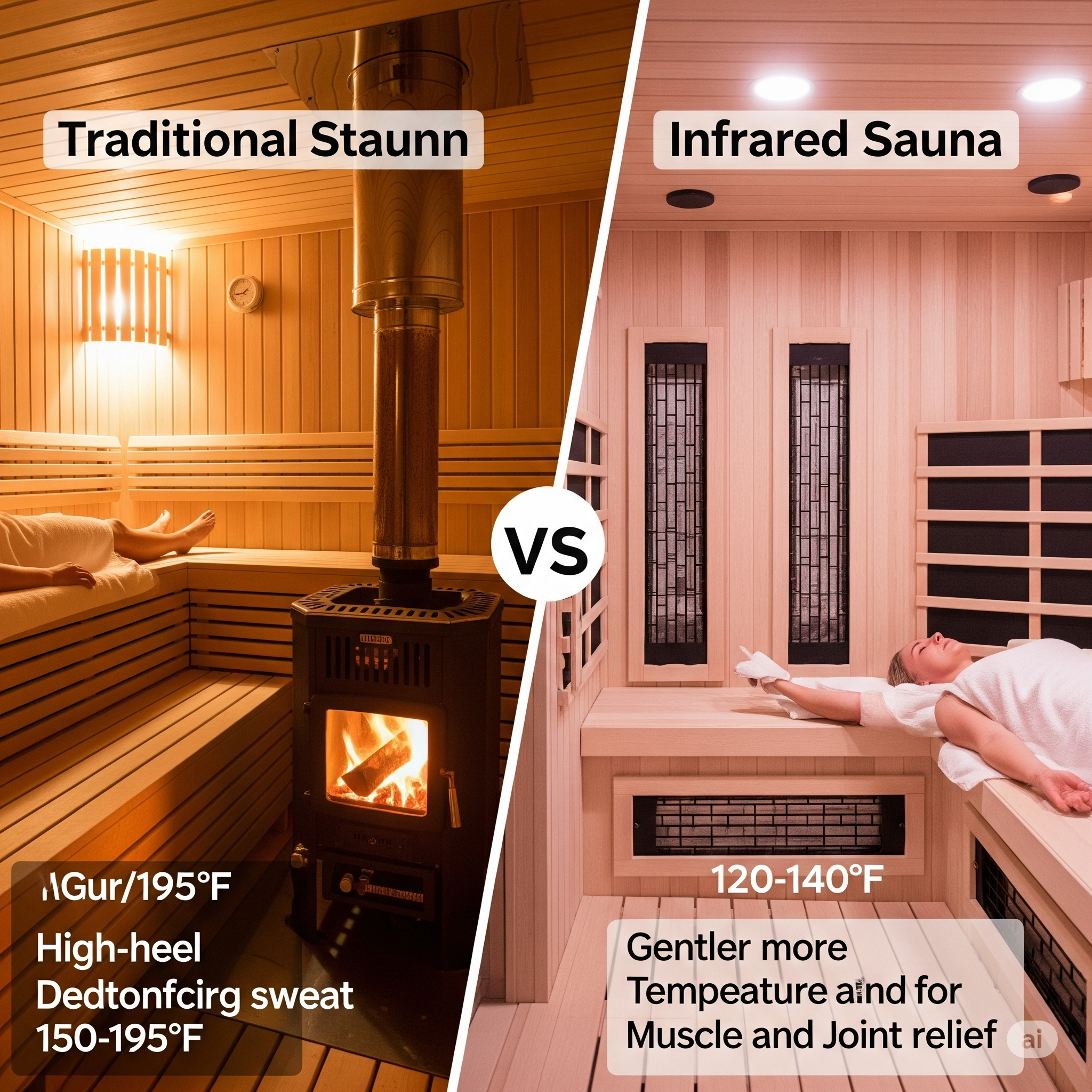
Infrared vs. traditional sauna — which is better?
The debate between infrared and traditional saunas is not about which produces more sweat — it is about which heat therapy experience matches your wellness goals, comfort preferences, and lifestyle. Both deliver compelling health benefits through different routes to the same destination: improved wellbeing through therapeutic heat. Here is everything you need to make the right decision for your home.
Expert Answer
For daily recovery, deep tissue relief, and heat-sensitive users: infrared sauna. For authentic Finnish experience, maximum cardiovascular stimulus, steam (löyly), and contrast therapy protocols: traditional sauna. Many serious wellness practitioners own both — using traditional for intensive contrast therapy sessions and infrared for daily maintenance recovery.
The Fundamental Difference: How Each Sauna Heats Your Body
The most important thing to understand about infrared vs. traditional saunas is that they work through completely different heating mechanisms — and that difference produces meaningfully different physiological experiences.
Traditional saunas heat the air in the room to extreme temperatures — typically 150–195°F — using an electric or wood-fired heater with stones. Your body heats through convection (hot air surrounding you) and conduction (contact with hot surfaces). The defining feature of traditional saunas is löyly — the Finnish practice of ladling water over heated stones to create an intense burst of steam, dramatically intensifying the heat experience. Saunas have been used in Finnish culture for thousands of years, and the traditional sauna represents one of the oldest wellness practices in human history.
Infrared saunas use infrared light panels to heat your body directly rather than heating the air around you. The panels emit infrared wavelengths that penetrate 1.5–2 inches beneath the skin's surface, heating muscles, joints, and connective tissue directly. This "inside-out" heating mechanism allows infrared saunas to operate at much lower ambient temperatures — typically 110–150°F — while still producing a deep, therapeutic sweat. Infrared technology is divided into near, mid, and far-infrared wavelengths, each penetrating to different depths and offering different benefits. Full-spectrum infrared saunas use all three simultaneously.

The heating method determines everything about the experience — ambient air heat vs. direct infrared tissue penetration produce distinctly different physiological responses.
Side-by-Side Comparison: The Key Differences
| Factor | Traditional Sauna | Infrared Sauna |
|---|---|---|
| Temperature | 150–195°F (65–90°C) | 110–150°F (43–65°C) |
| Heating method | Heats the air (convection) | Heats the body directly (radiation) |
| Tissue penetration | Surface level | 1.5–2 inches deep |
| Steam capability | Yes — löyly (water on stones) | No — always dry heat |
| Heat-up time | 30–40 minutes | 10–15 minutes |
| Session duration | 15–20 minutes recommended | 30–45 minutes comfortable |
| Power consumption | 6–8 kW | 1.5–2.5 kW |
| Monthly energy cost | $30–60 | $10–20 |
| Core temp rise | 1–3°F | 1–3°F |
| Electrical requirement | 240V / 30–50A dedicated circuit | 120V standard outlet (most models) |
| Contrast therapy | Ideal — highest thermal contrast | Effective but lower intensity |
| Installation complexity | Higher — ventilation, wiring | Lower — plug and play |
The Science: What Both Types Do to Your Body
Regardless of the heating method, both infrared and traditional saunas trigger the same fundamental physiological cascade when your core temperature rises: Heat Shock Protein (HSP) synthesis, cardiovascular stimulus mimicking moderate exercise, increased circulation, endorphin release, and autonomic nervous system recalibration. The Finnish longitudinal studies showing dramatic reductions in cardiovascular mortality and all-cause death were conducted on traditional sauna users — but the core temperature elevation that drives these benefits occurs in both types, meaning the underlying biological mechanism applies to both.
The difference is in the pathway to that core temperature rise, and what additional effects each pathway creates along the way.
What Traditional Saunas Do Better
Maximum Cardiovascular Stimulus
The extreme ambient heat of a traditional sauna (150–195°F) forces the body to work intensively to regulate core temperature — heart rate can increase by 50–75%, cardiac output improves, and blood vessels dilate dramatically. This cardiovascular response closely mirrors moderate aerobic exercise and is the primary driver behind the longevity data from Finnish sauna research. While infrared saunas produce a similar response, the lower ambient temperatures produce a comparatively lower cardiovascular intensity per session.
Steam and Löyly — Impossible to Replicate
The ability to pour water on heated stones and create an immediate, intense wave of steam is unique to traditional saunas and cannot be replicated by infrared technology. Löyly dramatically intensifies the heat experience, opens the respiratory tract, and creates the sensory environment — the sound of water hitting stone, the surge of humid heat, the distinctive cedar or spruce aroma — that defines authentic Finnish sauna culture. For users who have experienced traditional Finnish saunas and want to recreate that specific sensation at home, no infrared model can substitute.
Contrast Therapy Protocols
For contrast therapy — the alternation between heat and cold that drives the most significant neurological and metabolic benefits — traditional saunas produce a higher thermal differential. A transition from 185°F to 45°F produces a more powerful Parasympathetic Rebound, stronger vasodilation-vasoconstriction cycling, and a more intense physiological response than a transition from 140°F to 45°F. Our 2026 Contrast Therapy Guide recommends traditional saunas for maximum protocol effectiveness.
Cultural Authenticity and Social Experience
Traditional saunas have historically been communal spaces — in Finnish culture, the sauna is a sacred social environment where meaningful conversations happen and social bonds are formed. Larger traditional saunas accommodate multiple people comfortably, making them the natural choice for families or those who value the ritual, communal dimension of sauna use. As the Finnish proverb goes: "First build the sauna, then the house."
What Infrared Saunas Do Better

Infrared saunas operate at lower ambient temperatures while heating body tissue directly — producing a gentler, longer, and more accessible therapeutic session.
Deep Tissue Penetration for Targeted Recovery
Infrared wavelengths reach 1.5–2 inches beneath the skin's surface — heating muscles, joints, and connective tissue directly rather than working inward from the skin surface. This deeper penetration is particularly effective for chronic musculoskeletal pain, arthritis, sports injuries, and post-workout deep muscle recovery. Many physical therapists recommend infrared heat specifically for rehabilitation because it can increase blood flow to injured tissue, reduce joint stiffness, and target problem areas more precisely than ambient heat can.
Full Spectrum Infrared: Three Wavelengths, Three Benefits
Full-spectrum infrared saunas — like the Dynamic Lugano in our lineup — simultaneously deliver:
- Near-infrared: Penetrates the skin surface — promotes cellular repair, skin rejuvenation, and wound healing
- Mid-infrared: Reaches deeper soft tissue — improves circulation, reduces joint inflammation, supports cardiovascular health
- Far-infrared: Penetrates deepest into muscle tissue — detoxification, deep muscle recovery, core temperature elevation
This multi-wavelength approach provides a more comprehensive physiological response across different body systems simultaneously — something traditional saunas cannot replicate.
Accessibility and Daily Usability
The lower ambient temperature of infrared saunas (110–150°F vs 150–195°F for traditional) makes them accessible to people who cannot tolerate extreme heat — those with respiratory sensitivities, cardiovascular concerns, heat-sensitive medications, or who are simply new to heat therapy. The comfortable environment also allows for significantly longer sessions: most users can stay in an infrared sauna for 30–45 minutes vs the 15–20 minutes recommended for traditional saunas. Longer sessions produce more sustained therapeutic effects and allow for meditation, reading, or mindfulness practices that are impractical in intense heat.
Energy Efficiency and Installation
Infrared saunas use approximately 70% less energy than traditional saunas — 1.5–2.5 kW vs 6–8 kW — resulting in monthly energy costs of $10–20 vs $30–60 for traditional. Most infrared models plug into a standard 120V household outlet with no dedicated circuit required, making installation significantly simpler. Heat-up time of 10–15 minutes (vs 30–40 minutes for traditional) makes spontaneous daily sessions practical — you can decide to use it and be ready in the time it takes to change clothes.
Who Should Choose Each Type
Choose Traditional If You...
- Want authentic Finnish sauna with löyly steam
- Are doing contrast therapy protocols (sauna + cold plunge)
- Enjoy intense heat and high cardiovascular stimulus
- Plan to use it socially with family or guests
- Are installing outdoors as a permanent feature
- Want the maximum Heat Shock Protein response per session
- Are a purist who values cultural authenticity
Choose Infrared If You...
- Have heat sensitivity, respiratory issues, or cardiovascular concerns
- Are new to sauna and want an accessible starting point
- Want targeted deep tissue and joint pain relief
- Prefer longer, more meditative sessions (30–45 min)
- Want lower energy costs and simpler installation
- Have limited space or cannot modify electrical systems
- Want daily-use convenience without a 30-minute warm-up
Simple Decision Guide
- "I want authentic Finnish steam and löyly" → Traditional sauna — no infrared model replicates it
- "I want to do contrast therapy (sauna + cold plunge)" → Traditional — higher thermal differential = stronger response
- "I have joint pain or chronic muscle tension" → Infrared — deeper tissue penetration targets these specifically
- "I want to use it every day easily" → Infrared — 10 min heat-up, 120V plug-in, lower energy cost
- "I can't handle extreme heat" → Infrared — 110–150°F is accessible for most people
- "I want the absolute best wellness investment" → Both — use traditional for contrast therapy, infrared for daily maintenance
Is a Home Sauna Worth the Investment?
The short answer is yes — for anyone who uses it consistently. The long-term mathematics favor home ownership decisively. A professional sauna session typically costs $25–50 per visit. At 3–4 sessions per week, that is $3,900–$10,400 per year. A quality home infrared sauna in the $2,299–$4,000 range pays for itself in under 12 months. A traditional sauna in the $6,000–$16,000 range pays for itself in 1–4 years depending on frequency.
Beyond the financial calculation, the most significant benefit of home ownership is compliance. The research showing 40% reductions in all-cause mortality and 63% reductions in sudden cardiac death is based on consistent, frequent use — 4–7 sessions per week. That frequency is only sustainable when the sauna is in your home and requires no travel, booking, or social friction. Consistency is more important than duration; regular short sessions produce better results than infrequent intensive ones.
Collective Relaxation's Sauna Lineup
We carry both infrared and traditional saunas across every price tier, so you can choose the right type for your goals without compromise:
| Model | Type | Price | Best For |
|---|---|---|---|
| Dynamic Venice DYN-6210-01 | Far Infrared | $2,299 | Entry-level / daily use / apartments |
| Dynamic Lugano DYN-6336-03 FS | Full Spectrum Infrared | $3,899 | Best value / deep tissue / pain relief |
| Golden Designs Drammen GDI-8203-01 | Traditional | $13,999 | Authentic Finnish / steam / indoor-outdoor |
| Kohler C1 Indoor Sauna | Traditional | From $20,360 | Architectural / design-forward homes |
| ThermaSol Lumaria | Traditional | From $21,276 | Luxury spa / panoramic glass |
| Kohler C2 Outdoor Sauna | Traditional | From $35,813 | Premium outdoor / contrast therapy |
Frequently Asked Questions
Should I choose an infrared or traditional sauna for home recovery in 2026?
For daily recovery, deep tissue relief, and accessible daily use: infrared. For authentic Finnish experience, maximum cardiovascular stimulus, steam capability, and contrast therapy: traditional. If you are doing the sauna-cold plunge contrast therapy protocol, traditional saunas produce a higher thermal differential and stronger physiological response. If your primary goal is daily recovery, joint pain management, or you are heat-sensitive, infrared is the more practical choice. Many serious practitioners own both.
Do infrared saunas provide the same health benefits as traditional saunas?
Both types trigger the same core physiological responses — Heat Shock Protein synthesis, cardiovascular stimulus, increased circulation, endorphin release, and autonomic nervous system recalibration — because both elevate core body temperature by 1–3°F. The mechanisms differ: traditional saunas work harder through higher ambient temperatures, infrared works more directly through tissue penetration. The Finnish longevity research was conducted on traditional saunas, but the biological drivers of those benefits apply to both types. Infrared adds unique benefits (deeper tissue penetration, targeted relief, full-spectrum wavelengths) that traditional saunas cannot replicate.
How long should beginners stay in each type of sauna?
For traditional saunas: start with 5–10 minutes and build to 15–20 minutes over 2–3 weeks. The extreme ambient heat requires gradual adaptation. For infrared saunas: start with 10–15 minutes and build to 30–45 minutes — the lower temperatures allow faster adaptation. In both cases, leave immediately if you feel dizzy, nauseous, or overly uncomfortable. Hydrate before and after every session. Consistency over time matters more than session duration — 15 minutes daily is more beneficial than 45 minutes once a week.
Are infrared saunas more energy-efficient than traditional saunas?
Yes — significantly. Infrared saunas use 1.5–2.5 kW compared to 6–8 kW for traditional saunas, resulting in approximately 70% lower energy consumption. Monthly energy costs are typically $10–20 for infrared vs $30–60 for traditional. Infrared also heats up in 10–15 minutes vs 30–40 minutes for traditional, eliminating the energy cost of the warm-up period. For daily use at 3–4 sessions per week, the energy difference adds up to $200–$400 per year in savings.
Which sauna is better for weight loss?
Traditional saunas burn more calories per session — approximately 300–500 calories in 30 minutes vs 200–400 for infrared — due to the higher ambient temperatures requiring more thermoregulatory effort from the body. However, neither sauna type should be considered a primary weight loss strategy. The cardiovascular, metabolic, and longevity benefits are far more clinically significant than the caloric burn. Any weight loss from a single sauna session is primarily water weight that is replenished upon rehydration.
How frequently should I use a sauna to see health benefits?
The Finnish longitudinal studies showing the most significant cardiovascular benefits were based on 4–7 sessions per week. Meaningful benefits begin at 3 sessions per week. Consistency is more important than duration — regular short sessions (15–20 minutes) produce better cumulative results than infrequent long sessions. The health benefits of sauna use are cumulative and develop over months of consistent practice, with cardiovascular and HRV improvements typically becoming measurable within 3–6 weeks of regular use.
Can I combine infrared and traditional sauna use in the same wellness routine?
Yes — and many serious wellness practitioners do exactly this. A common approach is using a traditional sauna for contrast therapy sessions (paired with a cold plunge) 3 times per week, and an infrared sauna for daily passive recovery and deep tissue work on off days. The two types complement each other because they target different systems through different mechanisms. If budget allows only one, choose based on your primary goal: contrast therapy and cardiovascular benefit (traditional) or daily recovery and joint/tissue therapy (infrared).
Find Your Perfect Sauna at Collective Relaxation
We carry the full range — from entry-level infrared to architectural traditional — with personalized guidance to help you choose the right model for your goals, space, and budget.
📞 929-493-4366 | 📧 Jerry@CollectiveRelaxation.com | Mon–Fri 9am–5pm EST

Written by Jerry Vaiana — About Jerry


Leave a comment
This site is protected by hCaptcha and the hCaptcha Privacy Policy and Terms of Service apply.