The Ultimate Home Wellness Routine: A Daily & Weekly Plan That Actually Works
Key Takeaways
-
A good home wellness routine combines heat therapy, cold exposure, massage, and light therapy to create a complete recovery system that supports your body's natural healing processes.
-
Organizing your wellness activities into morning, afternoon, and evening routines helps maximize energy, focus, recovery, and sleep quality throughout the day.
-
You don't need to practice every wellness modality daily—consistency with 2-3 core practices is more valuable than sporadic, complex routines.
-
Heat therapy from saunas and hot tubs can reduce muscle tension, improve circulation, and promote relaxation when integrated into your weekly schedule.
-
Setting up dedicated wellness zones in your home, even in small spaces, dramatically increases the likelihood you'll maintain your routine long-term.
The difference between feeling constantly drained and experiencing daily vitality often comes down to one thing: a strategic wellness routine.
There's more to home wellness than just sporadic self-care. It's a science-supported method of controlling your biology and promoting total body health. With the advent of home saunas, cold plunges, hot tubs, massage chairs, and red light therapy, Thermosculpt's research reveals that those who establish regular home wellness routines experience a 68% increase in sleep quality and a 71% improvement in stress management compared to those who only visit spas occasionally.
Our in-depth guide will show you how to develop a wellness routine that fits your lifestyle, supports your health goals, and provides lasting results, without taking up hours of your day.
Home Wellness Revolution: The Importance of Your Daily Routine
Wellness has evolved from an occasional activity to a daily routine. The old model of scheduling appointments and trying to fit in spa days between busy schedules simply doesn't provide consistent benefits. Instead, incorporating scientifically proven wellness tools into your home can create a powerful environment for daily recovery.
A well-structured wellness routine at home is effective because it caters to your biology on several levels. Exposure to heat activates heat shock proteins and enhances cardiovascular function. Cold therapy decreases inflammation and strengthens the immune system. Massage relieves muscle tension and promotes lymphatic flow. Light therapy controls cellular energy production and balances hormones. When these methods are combined in a strategic manner, they form a complete system that aids your body's natural healing processes.
It's not about how hard you go, but how often you do it. Studies show that short daily wellness routines are much more effective than longer, inconsistent ones. For instance, spending 15 minutes in the sauna every day is more beneficial than spending an hour in the sauna once a week. This is true for all wellness routines—little by little, a little becomes a lot.

Key Elements of a Successful Home Wellness Routine
A great wellness routine is one that aligns with your body's natural daily rhythms and supports your various physiological needs throughout the day. Instead of seeing wellness as a one-off activity, consider it as a structure that enhances your whole day through deliberate actions at the right times.
Wake Up Energized and Focused with Morning Routines
What you do in the first half to full hour after you wake up can set the tone for your entire day. It can help you manage your stress levels and determine how your body will burn energy. A good morning wellness routine will wake up your body without causing you stress.
Begin your day with 2-3 minutes of deep, rhythmic breathing while you're still in bed. This helps your body understand that you're transitioning from a relaxed state to an alert yet calm state. Next, expose yourself to red light therapy for 5-10 minutes. Research has shown that this type of therapy can increase cellular energy production and help regulate cortisol.
If you're comfortable with temperature contrast, consider taking a 60-90 second cold shower or briefly immersing yourself in a cold plunge. This can significantly increase your alertness, motivation, and metabolic activity. Don't make your morning routine long and complicated. You don't want to use up all your morning energy. Instead, you want to create a regular signal that tells your body it's time to wake up and get moving.
Afternoon Revitalization Activities to Avoid Overworking
Many individuals have a natural energy decrease between 1-4 PM, as cortisol levels naturally drop and the stress of the day accumulates. This makes the afternoon one of the best times for a short wellness revitalization.
The perfect afternoon routine should include 5-10 minutes in a massage chair to prevent tension from building up. This helps to maintain a good posture and prevent the onset of chronic pain. After this, take a short break to hydrate and spend 1-2 minutes doing slow, deep breathing to reset your nervous system.
If you work from home, consider a quick 7-10 minute sauna session during your afternoon slump. The change in temperature will increase blood flow, mental clarity, and give you a natural energy boost without the crash that comes with caffeine.
Nightly Routines for Restful Sleep and Recovery
The time leading up to bedtime is an essential window for preparing your body for rejuvenating sleep, which is the bedrock of all other wellness habits. A nightly routine lets your nervous system know it's okay to shift into a recovery mode.
Studies have shown that taking a 15-20 minute sauna session or a 20-30 minute hot tub soak 1-2 hours before bedtime can improve the quality of deep sleep. This is because these activities raise the core body temperature and then allow it to drop, which is a natural trigger for the release of melatonin. If you don't have the space or the budget for a sauna or a hot tub, don't worry. You can achieve similar effects by taking a warm bath with magnesium salts.
For 5-10 minutes, focus on massaging areas where you usually feel tension, like your neck, shoulders, and feet. After that, spend some time in a dim room with red light therapy. This helps your body produce melatonin and lets it know it's time to get ready for bed.
Health Transforming Weekly Wellness Anchors
Though daily routines offer steady support, there are more intense wellness activities that act as weekly "anchors" providing deeper recovery. These sessions are usually longer and engage multiple systems at the same time.
Plan for one or two contrast therapy sessions every week. This is where you switch between being exposed to heat (like in a sauna or hot tub) and being exposed to cold (like in a cold plunge or cold shower) for two to three cycles. This strong practice sets off a series of adaptive responses that help with circulation, lessen inflammation, and boost mental resilience.
Set aside a day each week for a longer wellness routine—maybe 30-45 minutes of different wellness practices in a row. This more intense recovery day helps keep stress from building up and supports ongoing adaptation to your wellness habits.
Tuesday: Day for Recuperation
Tuesdays are perfect for focusing on recuperation to deal with the stress accumulated from Monday and to prepare yourself for a successful midweek. Start your morning with a 10-minute targeted massage, focusing on areas that are tense from your workweek. During lunch, incorporate a short 2-minute cold exposure (either a plunge or cold shower) to reduce inflammation and boost your immune system. Finish your day with 15-20 minutes in a hot tub or 15 minutes in a sauna to relax your muscles and prepare your body for a deep sleep.
Wednesday: Midweek Reset Routine
Wednesday is the perfect time to reset your system at the middle of the week. Start your day with a 5-minute red light therapy session to increase energy production at the cellular level. At noon, take 10 minutes for a full-body stretch sequence combined with focused breathing to clear your mind and release any built-up tension. In the evening, alternate between 5 minutes of sauna and 1 minute of cold exposure for 2-3 cycles to completely reset your nervous system and carry you into the second half of your week.
Thursday: The Power of Contrast Therapy
Thursday is a great day for a more intense contrast therapy session. This therapy uses the power of changing temperatures to create deep benefits for your body. Alternating between hot and cold creates a "vascular pump" effect that greatly improves your circulation and sets off a series of anti-inflammatory responses in your body.
Begin with 7-10 minutes of heat exposure (ideally in a sauna, but a hot shower will suffice if necessary), then immediately switch to 1-2 minutes of cold exposure. Repeat this cycle 2-3 times, always ending with cold to leave you feeling invigorated. This practice not only rejuvenates you physically but also provides incredible mental clarity to end your week on a high note.
Friday: Pre-Weekend Relaxation Techniques
On Fridays, it’s time to let go of the week’s stress and start preparing for a restful weekend. Begin your day with 5 minutes of red light therapy and slow breathing to create a calm baseline. Then, during your afternoon break, spend 10-15 minutes in a massage chair, focusing on your upper back, neck, and shoulders—areas where you’re likely to carry work-related tension.
Evenings are a great time for a social wellness activity. Ask your family or friends to join you for a 20-30 minute hot tub or sauna session. Studies have found that combining social interaction with heat therapy increases the stress-reducing benefits of both experiences and also strengthens relationships.
After a long, stressful week, unwind with a quick 5-minute meditation session in a dim room with soft red light. This light helps your body understand that it's time to relax and recover for the weekend, instead of carrying the stress from work into your personal life.
Weekly Rest and Relaxation Guide
To get the best results, try to hit these minimums each week:
-
Sauna: 3-4 sessions lasting 15-20 minutes each
-
Cold Exposure: 2-3 sessions lasting 1-3 minutes each
-
Massage: 4-5 sessions lasting 5-15 minutes each
-
Red Light Therapy: 4-6 sessions lasting 5-10 minutes each
-
Hot Tub: 2-3 sessions lasting 20-30 minutes each
Keep in mind: Regularity is more important than the intensity of the activity. You will gain more from a 5-minute daily session than a 60-minute session once a week.

Weekend Wellness: Deep Practices and Integration
Weekends offer the chance for deeper, more integrative wellness experiences. Saturday mornings are ideal for a complete wellness circuit: start with 15-20 minutes in the sauna, move on to 2-3 minutes of cold exposure, then finish with 15-20 minutes of massage therapy. This potent combination tackles physical recovery from multiple angles while creating the mental space for real relaxation. Sunday evenings are perfect for gentle preparation for the week ahead—10-15 minutes in a hot tub followed by red light therapy helps ready your body for quality sleep and sets a positive foundation for Monday morning.
Creating Your Home Wellness Spaces
The ease of access to your wellness tools greatly affects how often you'll use them. Studies have shown that people are 70% more likely to stick to wellness routines when the equipment is in sight and takes less than three steps to start using. By setting up dedicated wellness spaces in your home—even if you don't have a lot of room—turns sporadic practices into regular habits that provide ongoing benefits over time.
Practical Solutions for Small Spaces
Just because you have a small space doesn't mean you can't have a great wellness setup. Portable saunas that fold up when you're done using them offer almost all the benefits of their larger counterparts, but they don't take up nearly as much space. Inflatable cold plunges can be set up in your bathroom or on your balcony and drained after you're done, so you can do contrast therapy even if you live in an apartment.
Portable red light therapy devices provide focused advantages and can be tucked away in storage when not in use. Handheld massage guns provide intense relief from tension without taking up as much space as massage chairs. Even a small corner with a yoga mat and resistance bands can serve as a visual reminder to get moving.
The main idea is to keep your wellness tools in sight but out of the way. You want them to be easy to see to remind you to use them, but you don't want them to be so scattered that they cause stress. You can solve this problem with simple solutions like decorative screens, dedicated cabinets, or aesthetic organization systems.
For those with very little space, consider multi-purpose items: a bench that opens to hold yoga props, wall-mounted racks for massage tools, or under-bed storage containers for portable wellness equipment. The goal is to create a system where your tools are easy to get to for daily use but also easy to put away to keep the peace.
-
Portable infrared sauna blankets can be stored in closets and used on beds or floors.
-
Foldable massage mats provide full-body benefits without requiring dedicated space.
-
Window-mounted red light panels deliver benefits while saving valuable floor space.
-
Door-mounted organization systems keep smaller wellness tools visible and accessible.
-
Convertible furniture (ottomans, benches) can store equipment while serving other functions.
Setting up a Dedicated Wellness Corner
Even dedicating a 5' x 5' corner of your home to wellness can significantly increase practice consistency. This "wellness corner" serves as a visual reminder of your commitment and creates a psychological boundary between everyday activities and recovery time. Include your most frequently used modalities—perhaps a portable sauna, a meditation cushion, and a storage area for massage tools—and ensure the space feels inviting.
Consider incorporating items that stimulate various senses: a tiny plant for air filtration, a pleasant aroma from an essential oil diffuser, and maybe a sound machine for background noise that indicates "rest time". This multi-sensory strategy aids your brain in rapidly shifting into a parasympathetic state when you enter the room, making your wellness routines more effective.
Flexible Room Arrangements
Most of us don't have the luxury of a dedicated wellness room in our homes, so we need to get creative with our spaces. Bathrooms are a natural fit for contrast therapy, with showers offering cold exposure and portable saunas that can fit in larger bathrooms. Bedrooms are great for morning and evening red light therapy and massage tools that can be stored under the bed or in the closet.
You can turn your living room into a wellness space with a bit of strategic furniture placement. Put your massage chair somewhere where it will be used often and still fits in with your room's design. Or, arrange your furniture so there's room for a portable sauna when you want to use it. The trick is to incorporate wellness tools into your everyday life, instead of treating them like separate activities that need special arrangements.
How Wellness Routines Work
Wellness routines aren't just about feeling good in the moment. They create real, measurable changes in your body that build up over time. For example, regular exposure to heat through activities like using a sauna increases heat shock proteins. These proteins help repair damaged cells and improve how well your cells can handle stress. Cold exposure, on the other hand, activates brown fat, boosts your immune system, and triggers the release of norepinephrine, a hormone that improves focus and energy.
What's most crucial to remember is that mixing up your wellness routines creates a combined effect that is more powerful than any single practice on its own. The parasympathetic activation from massage boosts the recovery benefits of sauna sessions. The improved circulation from contrast therapy boosts the cellular energy production from red light therapy. This is why a well-thought-out wellness routine provides benefits that far exceed occasional spa visits or single-practice approaches.
Advantages of Heat and Cold Exposure
Exposure to heat and cold can create beneficial stress—hormesis—that can trigger adaptive responses throughout your body. Using a sauna can increase blood flow by up to 200%, delivering nutrients to tissues while removing metabolic waste. It also stimulates the production of growth hormones, supports mitochondrial function, and improves insulin sensitivity. When done 3-4 times a week, cold exposure can activate the vagus nerve, reduce inflammation, increase metabolism through the activation of brown fat, and strengthen the immune response through improved lymphatic circulation.
Improving the Quality of Your Sleep
Evening wellness routines can greatly improve the quality of your sleep by helping your body regulate its temperature. Using a sauna or hot tub 1-2 hours before bed can raise your body's core temperature. When your temperature drops afterward, it triggers the production of melatonin and deeper sleep cycles. Using red light therapy in the evening can support the natural production of melatonin and reduce the negative effects of blue light exposure on your sleep. Massages can also reduce physical tension that often turns into restlessness or discomfort during sleep cycles, especially when focused on the neck, shoulders, and lower back.
Ways to Reduce Stress
There are many ways that home wellness practices can help reduce stress. For example, heat exposure can lower cortisol levels and increase BDNF (brain-derived neurotrophic factor), which can improve your ability to handle stress and enhance your cognitive function. Massage can stimulate the release of oxytocin and serotonin while also decreasing cortisol, which can help you relax and increase your ability to handle stress in the long term. Surprisingly, voluntarily exposing yourself to mild stressors like cold therapy can actually improve your ability to handle everyday stress. This is because it strengthens your parasympathetic nervous system and helps your body return to its baseline more efficiently after a stress response.

How to Make Your Routine Work: Practical Application
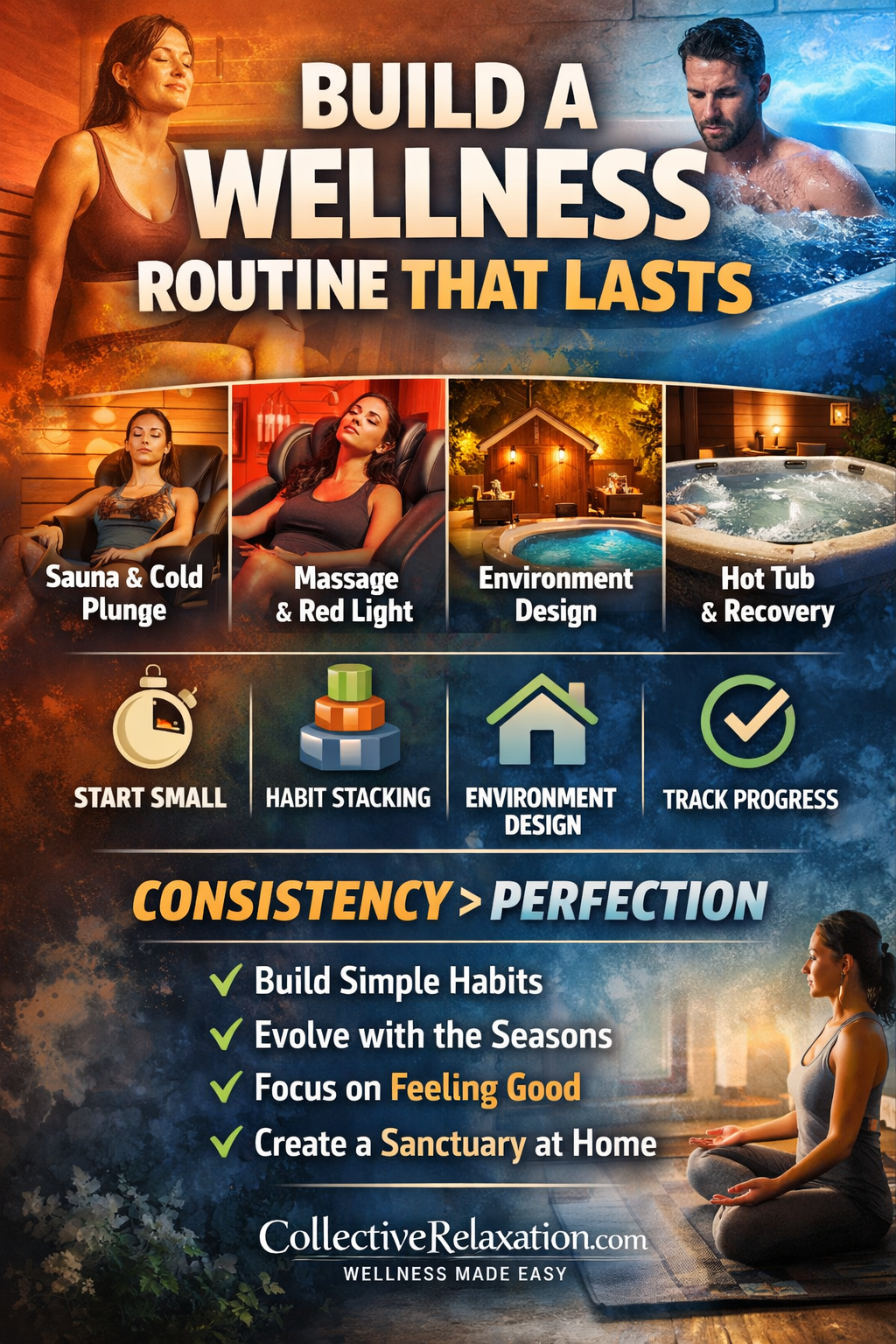
The best wellness routine is the one you'll actually stick to. Studies consistently show that consistency is more beneficial than intensity or complexity. A simple 10-minute daily practice that you stick to for months will create more profound changes than elaborate weekly rituals that you frequently skip when life gets busy.
Instead of trying to change everything at once, the secret to making things last is to carefully incorporate them into your current life. Begin with a wellness practice that meets your most urgent need, whether it's improving your sleep, reducing stress, or recovering physically. Only add more components once you've established a consistent routine.
-
Stack new wellness habits onto existing routines (morning coffee + red light therapy).
-
Create visual triggers that remind you of your wellness commitments.
-
Design your environment to make wellness practices easier than alternatives.
-
Track your habits with simple methods (calendar markings or basic apps).
-
Focus on consistency over duration—5 minutes daily beats 30 minutes occasionally.
Perhaps most importantly, approach your wellness routine as an evolving practice rather than a rigid system. Allow yourself to adjust based on your body's feedback, seasonal changes, and life circumstances. This flexibility ensures your routine remains supportive rather than becoming another source of pressure in your life.
Start Small: The 2-Minute Rule
The most effective way to create long-lasting wellness habits is by using the 2-Minute Rule. This rule involves committing to just two minutes of a new routine. This small commitment helps to overcome the mental block that often comes with starting a new habit, while also helping to create the neural pathways that make the habit stick. For instance, you might commit to just two minutes in the sauna every day, or two minutes of light therapy in the morning. Once you have the habit of starting, you can gradually increase the time you spend on it as you see fit.
This method is effective because it first focuses on creating the habit and then on maximizing its benefits. Start by consistently doing the activity for a short time to reduce resistance, then gradually increase the time to get the most physiological benefits. Most people find that once they've started a two-minute session, they naturally want to continue for the optimal duration because they've already overcome the initial resistance.
Building Consistency with Habit Stacking
Habit stacking is a proven method for incorporating wellness practices into your everyday routine. Rather than creating new habits from scratch, you can link your wellness activities to habits you already have. For instance, you could pair your morning red light therapy with your coffee routine, or your evening sauna session with your pre-bed skincare ritual. Studies have found that habits linked to existing triggers are 80% more likely to succeed than habits that are attempted on their own.
Make Your Environment Work For You
It's not realistic to depend on willpower alone to keep up with your wellness routine. Instead, set up your environment to make it as easy as possible to follow your wellness routine. Keep your most-used wellness tools in places you'll see them throughout your day. For example, keep your massage tools out in the open near where you relax in the evening, put your red light device in the bathroom where you get ready in the morning, and make sure your sauna or cold plunge pool is always ready to go.
-
Prep your equipment ahead of time to eliminate physical obstacles (for example, fill your cold plunge the night before).
-
Keep a clear schedule for different practices to avoid decision fatigue.
-
Set up visual cues that remind you of your wellness commitments.
-
Always have towels, water, and accessories ready to reduce friction.
-
Design pleasing sensory experiences around your wellness tools to make them more appealing.
This environmental strategy uses behavioral science by recognizing that our environment influences our actions much more powerfully than our intentions. A well-designed wellness environment makes healthy choices automatic, eliminating the need for constant conscious effort. Even small changes, like keeping your massage gun on your coffee table instead of in a drawer, can increase usage frequency by up to 70%.
Try to build areas in your house that naturally promote wellness activities. For instance, placing a little bench near your sauna or cold plunge gives a natural pause point that tells your brain it's time to transition into recovery mode. These slight environmental signals develop strong unconscious connections over time.
Don't forget that designing your environment isn't just about your physical surroundings - it also includes your digital spaces. You could set reminders on your calendar for your wellness activities, use alarms on your phone with unique sounds to signify that it's time for wellness, or even think about using apps that are designed to keep track of your wellness habits for that extra bit of motivation.
Keeping Tabs Without Going Overboard
Keeping a light record of your progress can help you stay accountable, but measuring too much can lead to stress that negates the benefits of your wellness routine. Instead of focusing on the outcomes, track your consistency—make a note of the days you complete your practices instead of constantly checking physiological markers. A simple calendar where you can record which wellness practices you've done each day can give you the satisfaction of seeing your progress without adding another stressor.
-
Focus on tracking consistency (days practiced) rather than duration or intensity.
-
Record subjective experiences alongside consistency (energy levels, sleep quality).
-
Review patterns monthly rather than daily to see bigger trends.
-
Celebrate streaks and consistency milestones to reinforce positive habits.
-
Adjust tracking methods based on what motivates your specific personality type.
For those who enjoy more detailed tracking, consider a simple journal where you note how you feel before and after your wellness practices. This creates awareness of the immediate benefits, strengthening your motivation to continue even on days when you feel resistant. Over time, this record becomes a powerful reminder of how your wellness routine supports your overall wellbeing.
Keep in mind that tracking is for your benefit, not the other way around. If you start to feel overwhelmed about keeping up perfect streaks or comparing your routine to others, then simplify your method. The aim is to have supportive accountability, not another stressor in your life.
Typical Errors in Wellness Routines to Steer Clear Of
Even the best laid wellness plans can fall apart if you don't take common mistakes into account. By recognizing these typical errors, you can create a more robust routine that can handle the ups and downs of everyday life instead of needing everything to be just right.
The most common mistake is trying to adopt too many new habits at once. This can be overwhelming and often leads to giving up on all the habits when life gets busy or tough. Instead, you should focus on mastering one wellness habit before adding another. This will allow each habit to become a solid part of your routine before you add more.
Avoiding the "All or Nothing" Mindset
Perfectionism is a major obstacle to maintaining a wellness routine. When people miss a few days, they often give up on their routine altogether. This leads to a cycle of starting and stopping that makes it hard to build momentum. Instead of falling into this trap, adopt the "minimum effective dose" approach. Figure out the smallest version of your routine that still has benefits. Then, when you're busy, do this shorter routine instead of skipping your routine altogether. Even two minutes in the sauna or a 30-second cold shower can help keep your habit alive and provide physical benefits.
Keeping it Simple
When it comes to wellness, the simpler, the better. Many people who are keen on wellness often set up complicated routines that require specific timing, sequences, and conditions. But these can be hard to stick to in the real world. The routines that work best are those that are flexible and can adapt to different situations, while still keeping the main parts of the routine.
Make it easy on yourself by determining the non-negotiable elements of each practice (temperature, basic duration) while leaving room for flexibility in timing, sequencing, and secondary factors. This adaptability ensures your routine can withstand travel, busy workweeks, and other life variables that are bound to come up.
Not Considering Individual Needs
Trying to follow a one-size-fits-all wellness routine without adjusting it to your own body, tastes, and objectives is a recipe for failure. The best routine for you should match your sleep-wake preference (whether you're a morning person or a night owl), provide the recovery you need, and go with the flow of your natural inclinations rather than against them.
Make sure to pay attention to how various techniques impact your body. Some folks find that using a sauna in the evening helps them sleep better, while others have difficulty sleeping after a sauna. Some people find that cold exposure in the morning is beneficial, while others find that it causes them to feel stressed. These personal differences are far more important than adhering to prescriptive procedures intended for the "average" person.
The Path to Wellness: Lifelong Health Strategies
Creating a successful wellness routine is not a fixed end-point but a dynamic journey that evolves with you. The practices that are beneficial for you today may need to be modified as your body, situation, and objectives change over time. This flexibility—rather than strict adherence to a particular regimen—is what leads to lasting wellness through the various stages of life.
-
Start with a single wellness practice that addresses your most pressing current need.
-
Master consistency with that practice before adding additional modalities.
-
Periodically reassess which practices deliver the most significant benefits for you.
-
Adjust your routine seasonally to account for changing environmental conditions.
-
Gradually build a personalized toolkit of practices you can draw from as needed.
Remember that wellness is ultimately about supporting your life's purpose rather than becoming another obligation. The most effective routine enhances your energy, focus, and resilience for the activities and relationships that matter most to you. When designed thoughtfully, your wellness practices should feel like a gift to yourself rather than another item on your to-do list.
While you're getting used to your routine, think about occasionally trying new methods that could go well with your current routine. Our knowledge of what works best for wellness is always changing, and being open to new, proven ideas can greatly improve how well you do in the long run and keep you interested in your routine.
Commonly Asked Questions
When you begin to create your wellness routine, you might have questions about how to make it the most effective, how to solve any problems that come up, and how to adjust the routine to fit your personal needs. Here are some answers to the most common questions people have when they start to create a wellness routine at home.
Keep in mind that while the basic rules are widely applicable, the most effective method always includes a certain amount of customization and experimentation to find out what works best for your specific body and situation.
How long should my daily wellness routine take?
It's not about how long you spend, but how regularly you do it and the quality of your routine. Studies have found that for most people, a total of 20-30 minutes a day is best. You can break this down into 5-15 minute chunks throughout the day. This could be 5-10 minutes in the morning, a 5-minute break in the afternoon, and 10-15 minutes to wind down in the evening. If you're new to this, even 10-15 minutes a day can make a big difference, as long as you stick to it.
Instead of zeroing in on random time goals, concentrate on the least effective dose that brings about perceptible enhancements in the way you feel. For a few, this may be 15 minutes daily, while others benefit most from 30-40 minutes spread for the duration of the day. The key is tracking down the sweet spot where your routine conveys significant advantages while staying maintainable with your way of life.
Is it possible to create an effective wellness routine without breaking the bank?
Definitely. Although having dedicated equipment can make things more convenient and offer some extra benefits, there are plenty of effective wellness practices that don’t require you to spend much money. You can get the benefits of cold exposure by taking cold showers or partially submerging yourself in an ice bath that you make in your regular bathtub using bags of ice. You can get the benefits of heat by taking hot baths that you enhance with magnesium salts or by using portable sauna blankets that are much cheaper than full saunas but still offer many of the same benefits.
What matters most is not the complexity of your tools, but how often you use them. Even the most basic tools can provide significant benefits if used on a regular basis, while the most advanced equipment can be of little use if rarely used. Start with simple, inexpensive options to get into the habit, then slowly invest in more specialized equipment for the methods that you find most helpful for your individual needs.
When will I start seeing the effects of my new wellness routine?
Most people see immediate short-term effects of wellness routines—better mood, improved sleep, or less muscle tension—within the first 1-3 sessions. However, the more significant long-term effects usually start to show after 2-3 weeks of regular practice as your body starts to react to the routine. Significant changes in stress resilience, energy levels, and recovery ability usually become noticeable after 4-8 weeks of regular practice, with continued improvements developing over 3-6 months as your body fully adapts to the wellness routine.
Should I stick to my wellness routine even if I'm tired or sick?
If you're feeling fatigued but otherwise healthy, a lighter version of your wellness routine can often give you the energy boost you need. Gentle heat therapy, mild exercise, and short periods of cold exposure can help you regain energy rather than further draining it. However, when you're actively sick, it's more important to rest and recover than to push yourself. Moderate heat therapy can support your immune system in the early stages of illness, but you should avoid intense cold exposure or strenuous activity until you're well again. Always pay attention to your body's cues and be ready to reduce the intensity or take a break when you really need to, without giving up on your routine completely.
If I can only do one thing for my wellness, what should it be?
Temperature contrast therapy is the best single practice for wellness. This means you expose yourself to heat (like a sauna or hot shower) for a short time, and then to cold (like a cold shower or plunge). This causes your body to react in ways that are good for your health. It improves your circulation, reduces inflammation, helps your immune system, makes you feel better, and helps you recover from exercise. This practice is good for many different systems in your body at the same time. So, if you only have time or resources to do one thing, this is the best choice.
If you don't have access to contrast therapy, regular sauna use (3-4 times a week for 15-20 minutes) is the next best thing. It's particularly beneficial for cardiovascular health, stress reduction, and improved recovery. If heat therapy isn't an option, a daily 10-15 minute full-body massage with a percussion device can also relax and help you recover.
Building a home wellness routine has become one of the most powerful ways to reduce stress, increase productivity, and improve overall well-being. By incorporating simple daily practices, individuals can create a balanced lifestyle that supports both mental and physical health. Whether it's through meditation, exercise, or healthy eating, establishing a routine that prioritizes self-care can lead to significant improvements in one's quality of life.
To start building your own sanctuary with the best saunas, cold plunges, massage chairs, and red light therapy devices, visit CollectiveRelaxation.com.
Written by Jerry Vaiana — About Jerry


Leave a comment
This site is protected by hCaptcha and the hCaptcha Privacy Policy and Terms of Service apply.