Best Home Wellness Setup of 2026: Sauna, Cold Plunge & Recovery Systems Compared
People aren't just buying wellness products anymore — they're building environments. A dedicated home wellness setup changes how you recover, sleep, manage stress, and feel every single day. This guide cuts through the noise and shows you exactly what makes a complete setup, how to build one at every budget level, and what to consider before you spend a dollar.
The Core Answer
The most effective home wellness setup combines heat therapy (sauna) with cold therapy (cold plunge) — used together as contrast therapy or independently based on your daily goal. Heat opens the body, reduces stress, and promotes deep sleep. Cold resets the nervous system, boosts energy, and accelerates recovery. Together, they produce physiological benefits neither can achieve alone. Start with one, build toward both, and let consistency do the work.

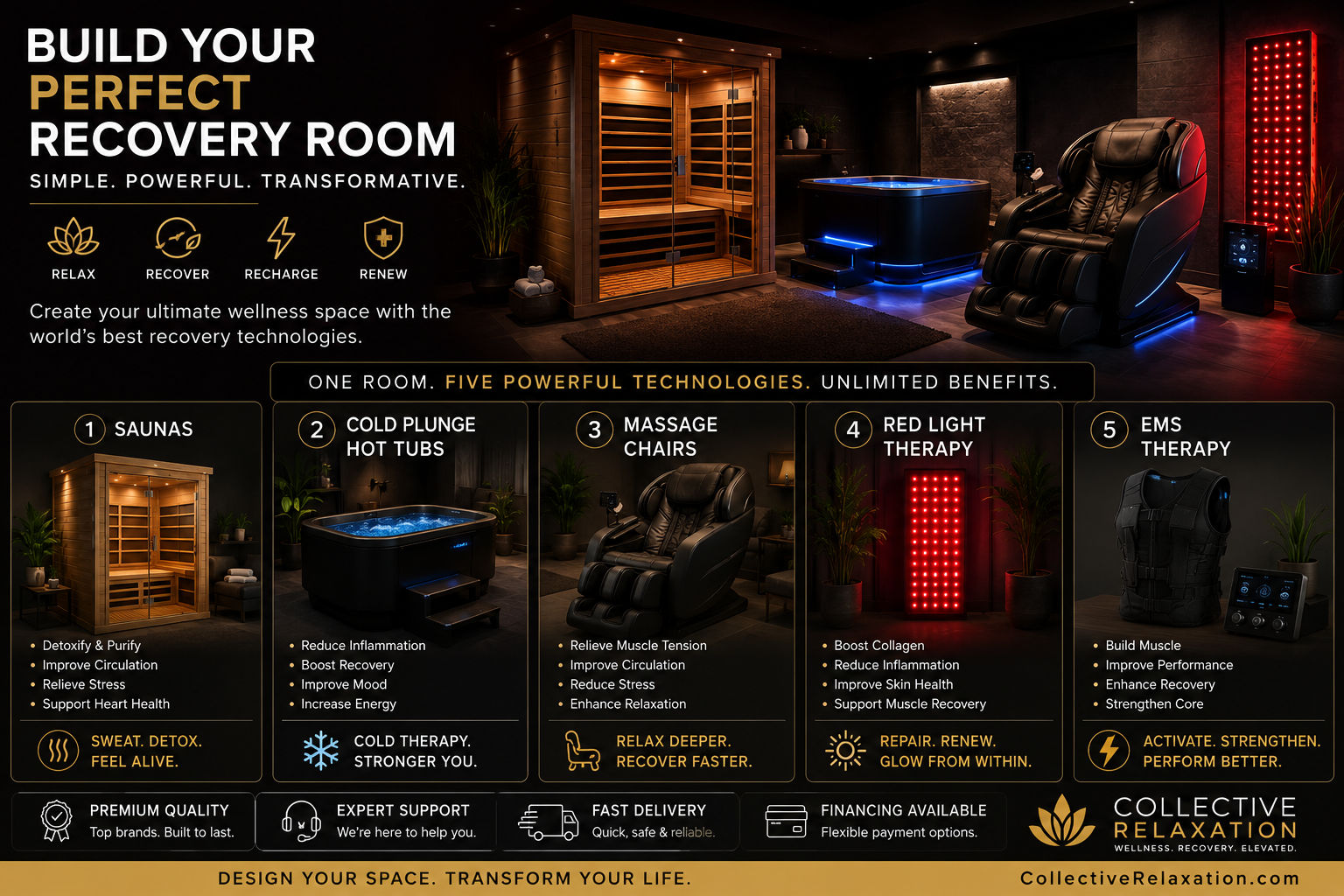
A complete home wellness environment combines multiple recovery modalities — designed for daily use, not occasional sessions.
What Actually Makes a Complete Home Wellness Setup
A real setup is not about having everything. It is about having the right combination — tools that work together to address the full spectrum of what most people actually need from a wellness practice: stress relief, better sleep, faster recovery, and daily energy management.
The two core modalities that form the foundation of every effective home wellness setup are heat therapy and cold therapy. Everything else — red light therapy, EMS, massage chairs — adds to that foundation. But the foundation itself is what determines whether your setup actually changes how you feel every day or just takes up space.
Heat Therapy: The Sauna
The sauna is where most people start — and for good reason. Heat therapy produces a specific physiological cascade that is difficult to replicate any other way. Your blood vessels dilate, improving circulation throughout the body. Cortisol levels drop as the nervous system shifts from sympathetic (stress) to parasympathetic (recovery) dominance. Heat shock proteins activate, supporting cellular repair. Core body temperature rises, and the subsequent cooling after your session triggers a strong melatonin release — making a sauna one of the most effective sleep interventions available.
But what most people don't anticipate is the behavioral shift. A sauna becomes one of the few spaces in a home where nothing else competes for your attention. No screens, no notifications, no demands. That enforced stillness is part of the benefit — and over weeks, the body begins to associate the ritual with rest.
The Sleep Connection: Finishing a sauna session 60–90 minutes before bed produces a faster and more pronounced core temperature drop than the body generates on its own — a signal the hypothalamus interprets as time to sleep. Studies show this reduces sleep onset latency by an average of 10–15 minutes and increases slow-wave deep sleep duration. For the full protocol, see our Sauna and Sleep guide.
Cold Therapy: The Cold Plunge
Cold exposure is where the setup shifts from relaxing to activating. Cold water immersion is not comfortable — and that is precisely the point. The controlled discomfort triggers a powerful neurochemical response: norepinephrine surges 200–300% above baseline, dopamine rises and sustains for hours, and the body's stress-response systems strengthen through repeated hormetic exposure. The result is improved mental clarity, elevated baseline energy, and a measurably faster recovery from training.
Cold also does something that heat cannot: it reduces acute inflammation rapidly. For anyone training hard, managing chronic pain, or simply dealing with the physical toll of a demanding schedule, this anti-inflammatory effect is significant and immediate.
Why Heat and Cold Work Better Together
Heat opens the body. Cold resets it. Used in sequence as contrast therapy, the alternating vasodilation and vasoconstriction creates a powerful circulatory pumping effect that drives blood, oxygen, and nutrients through muscle tissue while clearing metabolic waste. The combined protocol outperforms either modality used alone across every recovery metric studied.
The transition between heat and cold — stepping from a hot sauna into cold water — produces its own physiological response that neither experience creates independently. It is this transition that makes contrast therapy one of the most effective recovery protocols available outside a professional sports facility. For the full science and timing, see our Ultimate Contrast Therapy Guide.
The 3 Levels of Home Wellness Setups
You do not need to go all-in immediately. But understanding where you are — and where you want to go — helps you avoid the most common mistake: buying at a level that doesn't match your actual usage pattern and ending up with equipment you don't use.

Each setup level represents a different relationship with your wellness practice — from building the habit to making it a permanent part of your home environment.
Level 1: Starter Setup ($2,000–$5,000) — Where Consistency Begins
The starter level is not about perfection. It is about removing friction. The single biggest predictor of whether a wellness setup actually delivers results is whether you use it consistently — and the starter level is specifically designed to make that as easy as possible.
| Component | What to Look For | Approximate Cost |
|---|---|---|
| Infrared Sauna | 1–2 person plug-and-play 120V unit, solid wood construction, full-spectrum or near-infrared panels | $1,500–$3,500 |
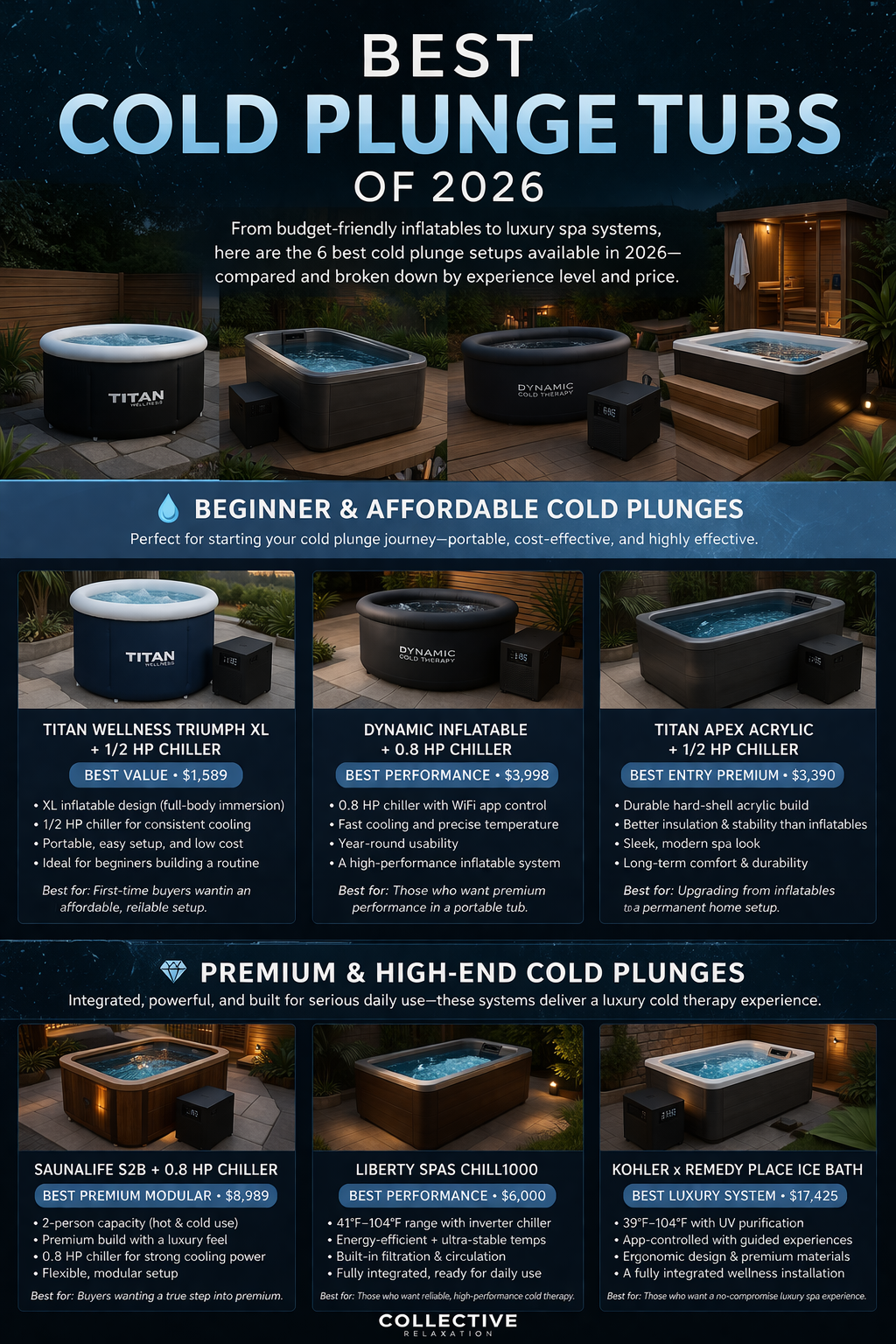
| Cold Plunge | Insulated tub or inflatable barrel with optional entry-level chiller for temperature control | $500–$1,500 |
At this level, you walk in, turn it on, and use it. There is no complicated installation, no electrician required, no planning involved. The infrared sauna plugs into a standard 120V outlet. The cold plunge can be as simple as an insulated barrel with ice or an entry-level chiller unit.
The limitations are real and worth acknowledging: less precise temperature control, less durability over years of daily use, and a setup that does not quite feel built-in. But for someone who has never maintained a consistent sauna or cold plunge habit, these limitations are secondary to the primary goal — building the routine.
Level 2: Mid-Level Setup ($5,000–$15,000) — Where It Becomes Part of Your Life
This is where most serious wellness users land — and stay. The mid-level setup is not just better equipment. It is a different relationship with the practice. At this level, you stop thinking about whether to use it and simply go — because it is ready, it works precisely, and it feels genuinely good every time.
| Component | What to Look For | Approximate Cost |
|---|---|---|
| Infrared or Traditional Sauna | 2–3 person unit, full-spectrum infrared or traditional Finnish with quality heater, chromotherapy, app control | $3,500–$8,000 |
| Cold Plunge with Chiller | Purpose-built tub with automated chiller maintaining 45°F–55°F consistently, filtration system | $2,000–$5,000 |
| Red Light Therapy (optional) | Panel system for full-body coverage, verified 660nm/850nm wavelengths | $500–$1,500 |
The defining upgrade at the mid-level is temperature consistency. An automated chiller maintains your cold plunge at precisely 50°F without manual intervention. A quality sauna heater holds temperature reliably session after session. This consistency is not just a luxury — it is what makes the protocol reproducible, which is what makes it effective over months and years.
At this level, the setup starts to integrate with your home rather than just occupying space in it. A 240V traditional sauna in the garage. A chiller-equipped cold plunge on the back deck. A red light panel in the bedroom or home gym. Each component earns its place by being genuinely used rather than aspirationally owned.
Level 3: Premium Setup ($15,000–$40,000+) — A Space, Not a Setup
At the premium level, the conversation shifts from equipment to environment. You are not buying products — you are building a space. A dedicated wellness room, a backyard retreat, an indoor spa designed for daily use that integrates seamlessly with how you live. The equipment at this level is exceptional, but the real value is in the design — the fact that the space invites use rather than requiring motivation.
| Component | What to Look For | Approximate Cost |
|---|---|---|
| Premium Sauna | Custom outdoor barrel or cabin, Kohler C-series, traditional with HUUM or Harvia heater, full chromotherapy | $8,000–$20,000+ |
| Premium Cold Plunge | Stainless or wood-finished tub, commercial-grade chiller 37°F–65°F, smart app controls, ozone filtration | $5,000–$12,000 |
| Red Light Therapy | Professional-grade panel system, high irradiance, full-body coverage | $1,000–$3,000 |
| Massage Chair | AI body-scan, 4D/8D rollers, zero-gravity, full compression — Kahuna or Kyota | $7,000–$17,000 |
The Kohler C2 Outdoor Sauna is one of the flagship options at this level — a beautifully designed outdoor unit that functions as both a premium wellness tool and an architectural feature of your property. Combined with a professional-grade cold plunge, a high-irradiance red light panel, and a premium massage chair, this level of setup produces a daily wellness routine that rivals what was previously only available in professional spa and sports medicine facilities.
What to Think Through Before Building Your Setup
This is where most mistakes happen — not in what people buy, but in what they don't think through first. Every piece of equipment in this guide works. Whether it works for you depends on how well it fits your actual living situation and usage pattern.

Outdoor setups create a genuine sense of retreat — the physical separation from the house reinforces the mental separation from daily stress that makes the practice so effective.
Space: Indoor vs Outdoor
The most fundamental decision is where your setup lives. Indoor setups offer easier daily access, better integration with your existing routine, and year-round usability regardless of weather. Outdoor setups create a genuine sense of escape — the act of stepping outside to use your sauna or cold plunge reinforces the psychological separation from daily stress that makes the practice valuable. Outdoor setups also typically allow for larger units and more immersive environments.
Think about the path between your sauna and cold plunge — ideally no more than 10–15 seconds apart for contrast therapy. Consider lighting for evening use, and privacy for relaxed, distraction-free sessions.
Electrical Requirements
Electrical planning is where most setups get delayed or compromised. Understanding what you need before you buy prevents expensive surprises.
| System Type | Voltage | Installation | Best For |
|---|---|---|---|
| Small infrared sauna, basic chiller | 120V | Plug-and-play, no electrician | Starter setups, renters |
| Traditional sauna, strong chiller | 240V | Licensed electrician required | Mid-level and premium setups |
| Full premium system | 240V dedicated circuit | Electrical panel upgrade may be needed | Premium builds |
The jump from 120V to 240V is where performance meaningfully improves — but also where complexity increases. Budget for professional installation at the mid-level and above. It is not optional for a traditional sauna or a quality chiller unit, and it is money well spent for a setup you will use daily for years.
Frequency of Use — Be Honest
This single variable determines which level makes sense for you more than any other factor. The research on sauna and cold plunge benefits is built on consistent, regular use — 3–5 sessions per week over months. Equipment that is too complex, too uncomfortable, or too difficult to access consistently will not be used at that frequency, regardless of its quality.
- 1–2 times per week: Starter setup is appropriate — don't over-invest
- 3–5 times per week: Mid-level delivers the consistency and reliability this frequency demands
- Daily: Premium or strong mid-level — durability and ease of use become critical
Matching Your Setup to Your Primary Goal
| Primary Goal | Start With | Add Next |
|---|---|---|
| Better sleep and stress relief | Infrared sauna | Cold plunge (morning use) |
| Athletic recovery and reduced soreness | Cold plunge | Sauna (contrast therapy) |
| Daily energy and mental clarity | Cold plunge | Red light therapy panel |
| Anti-aging and skin health | Red light therapy | Infrared sauna |
| Chronic back pain and muscle tension | Massage chair | Infrared sauna |
| Full recovery stack | Sauna + cold plunge | Red light + massage chair |
Adding the Third Layer: Red Light Therapy and Massage Chairs
Once a sauna and cold plunge foundation is established, two additional modalities consistently earn their place in a serious home wellness setup.
Red Light Therapy
Red light therapy (600–900nm) stimulates cellular repair, boosts collagen production, reduces inflammation, and supports mitochondrial function in muscle tissue. It fits naturally into the recovery stack as the final step — after circulation has been optimized by contrast therapy, red light accelerates the cellular repair process that follows. A 10–20 minute session targeting worked muscle groups or the face produces measurable results with daily use over 4–8 weeks. For a detailed breakdown, see our Red Light Therapy guide.
Massage Chair
A quality massage chair earns its place in a home wellness setup by providing daily passive recovery with zero friction — no preparation, no temperature management, no willpower required. Modern AI-equipped chairs like the Kahuna DIOS-1288 8D or Kyota Nokori M980 provide full-body compression, zero-gravity spinal decompression, and targeted deep-tissue work that complements the active recovery of sauna and cold plunge. It becomes the tool that holds the routine together on days when nothing else happens. For full comparisons, see our Best Massage Chairs of 2026 guide.

The full recovery stack — sauna, cold plunge, red light therapy, and massage chair — addresses every dimension of physical recovery and stress management from a single home environment.
The Natural Progression: How Most Setups Evolve
Almost no one builds the full stack on day one. The pattern that plays out consistently among serious home wellness users looks like this: they start with one piece, use it consistently, feel the difference, and the next addition becomes obvious rather than aspirational.
The sauna user starts craving the contrast of cold and adds a cold plunge. The cold plunger wants the deeper relaxation of heat and adds a sauna. Both eventually find that red light fits naturally as the final step in the recovery sequence. The massage chair earns its place as the daily baseline — the tool that gets used even on days when nothing else does.
You do not need everything at once. You need the first step — and the commitment to use it consistently enough to feel what it does. Once you feel it, the next step tends to take care of itself.
Frequently Asked Questions
What is the best home wellness setup for 2026?
The most effective home wellness setup combines a sauna with a cold plunge — used together as contrast therapy or independently based on your daily goal. Heat therapy reduces stress, improves sleep, and supports cardiovascular health. Cold therapy boosts energy, reduces inflammation, and accelerates recovery. Together they produce benefits neither modality achieves alone. Red light therapy and a massage chair add meaningful layers once the core foundation is established. The best setup is the one you will actually use consistently — start at the level that matches your realistic usage pattern.
How much does a complete home wellness setup cost?
A functional starter setup with an infrared sauna and basic cold plunge starts around $2,000–$5,000. A mid-level setup with a quality sauna and chiller-equipped cold plunge typically runs $5,000–$15,000 and represents where most serious users land long-term. A premium setup with a dedicated outdoor or indoor wellness space, premium sauna, professional cold plunge, red light therapy, and massage chair ranges from $15,000 to $40,000 and above. In all categories, mid-range spending delivers the best value — the performance gap between entry and mid-level is significant, while the gap between mid-level and premium is more marginal for most users.
Should I get a sauna or cold plunge first?
It depends on your primary goal. If you want better sleep, stress relief, and a daily relaxation ritual, start with an infrared sauna — the benefits are immediate and the habit forms naturally. If you want energy, mental clarity, and faster athletic recovery, start with a cold plunge — the neurochemical response is immediate and measurable from the first week. Most people eventually build toward both. If you genuinely cannot decide, a sauna is the easier habit to form and the more universally accessible starting point. For a detailed comparison, see our guide on What Should I Buy First.
What is contrast therapy and does it work at home?
Contrast therapy is the practice of alternating between heat exposure (sauna) and cold immersion (cold plunge) in repeated cycles. The alternating vasoconstriction and vasodilation creates a powerful circulatory pumping effect that accelerates metabolic waste clearance, reduces muscle soreness, and balances the nervous system more effectively than either modality used alone. It works exceptionally well at home — you simply need a sauna and a cold plunge positioned within reasonable distance of each other. The standard protocol is 10–15 minutes in the sauna, 2–3 minutes in the cold plunge, repeated for 2–3 cycles, always finishing with cold.
Do I need a 240V outlet for a home sauna setup?
It depends on the sauna type. Small infrared saunas (1–2 person) typically run on standard 120V and plug directly into a wall outlet — no electrician required. Traditional Finnish saunas, larger infrared units, and most quality cold plunge chillers require a 240V dedicated circuit and professional electrical installation. Budget for this installation cost when planning a mid-level or premium setup. The performance improvement from 240V over 120V is significant and the installation is a one-time cost that pays for itself over years of daily use.
Is an outdoor or indoor sauna better for a home setup?
Both work effectively — the right choice depends on your space, climate, and how you want to use it. Indoor saunas offer easier daily access, year-round usability regardless of weather, and simpler integration into your existing routine. Outdoor saunas create a genuine sense of escape and typically allow for larger, more immersive units. For contrast therapy, outdoor setups can be ideal — positioning the sauna and cold plunge side by side in a backyard creates a seamless transition between heat and cold. For daily evening use focused on sleep, an indoor unit that is immediately accessible tends to drive higher consistency.
How often do I need to use my home wellness setup to see results?
The research on sauna and cold plunge benefits is built on consistent use — 3–5 sessions per week over months. Finnish longitudinal studies show the most significant cardiovascular benefits at 4–7 sessions per week. Even 2–3 sessions per week produces measurable improvements in recovery markers, sleep quality, and stress resilience within 4–6 weeks. Consistency matters far more than session length or intensity. A 15-minute sauna session three times a week for two months produces better outcomes across every measured variable than a single 45-minute session every few weeks.
Build Your Home Wellness Setup at Collective Relaxation
Every product we carry is chosen based on one standard: does it actually deliver what it promises when used daily in a real home? Contact us — we will help you design the right setup for your space, goals, and budget.
📞 929-493-4366 | 📧 Jerry@CollectiveRelaxation.com | Mon–Fri 9am–5pm EST
Written by Jerry Vaiana — About Jerry


Leave a comment
This site is protected by hCaptcha and the hCaptcha Privacy Policy and Terms of Service apply.