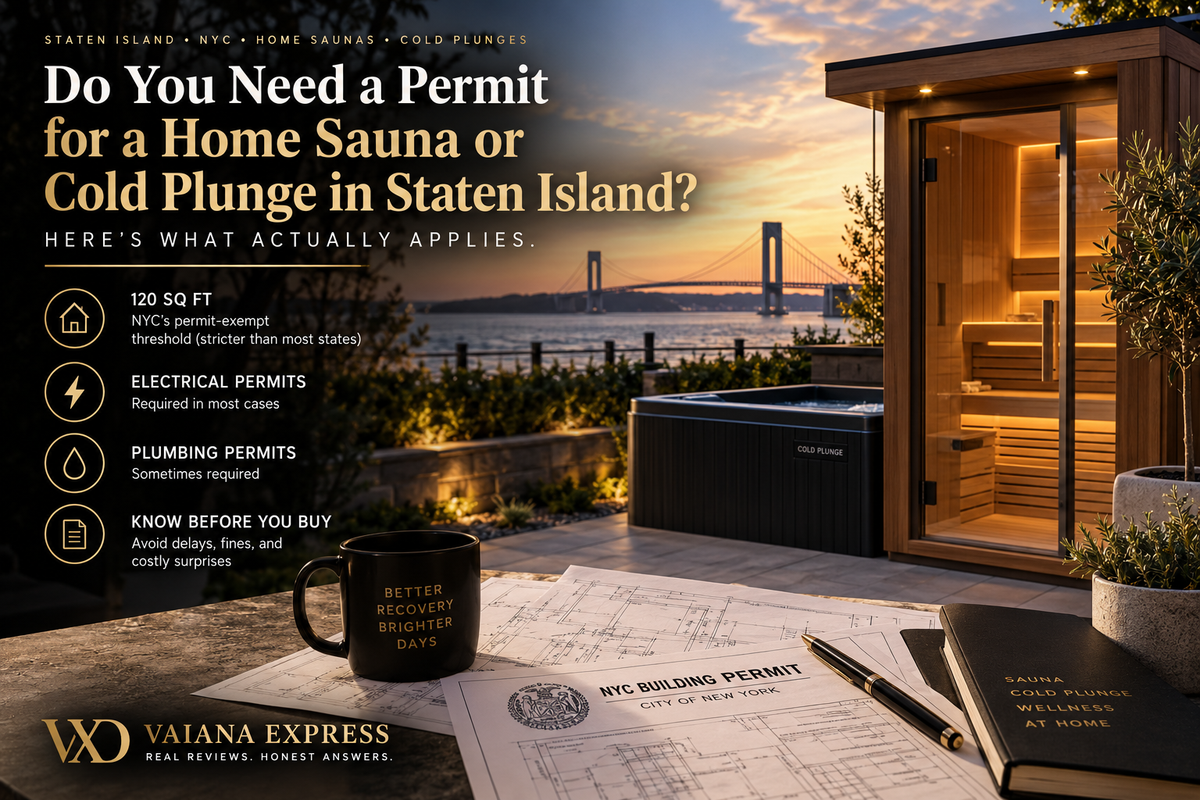
Do You Need a Permit for a Backyard Sauna or Cold Plunge in Staten Island? (NYC Homeowner's Guide 2026)
Yes — in most cases you need at least an electrical permit to install a home sauna or cold plunge chiller in Staten Island, even if the unit itself is small enough to skip a building permit. New York City sets its own permit-exempt threshold at 120 square feet, which is stricter than the state's default 144-square-foot rule that most national guides quote. Below is exactly what applies to a Staten Island backyard, indoor room, or basement — and who to call before you buy.
- Why NYC permit rules are stricter than the rest of the country
- The 120-square-foot exemption — what it actually covers
- Electrical permits: the one almost no sauna or cold plunge skips
- When you need a plumbing permit
- DOB permits vs. the NYC Health Department bathing establishment permit
- Staten Island zoning: setbacks and lot coverage
- Permit requirements at a glance
- Indoor saunas: what changes
- Cold plunges and chillers: what's different from a sauna
- Who to actually call in Staten Island
- Getting it right from the start
- Frequently asked questions
Why NYC permit rules are stricter than the rest of the country
Most sauna buying guides give you a national answer: check your state's small-structure exemption, get an electrical permit for the heater circuit, done. That advice is accurate almost everywhere in the country — and it's incomplete for New York City. NYC operates under its own construction codes, administered by the Department of Buildings (DOB), layered on top of the New York State Residential Code. Where the state code gives municipalities the option to exempt small detached structures up to 144 square feet from a building permit, New York City chose not to adopt that number. The city set its own, smaller threshold instead.
That single difference is why a sauna or cold plunge install that would be permit-exempt in most Long Island or Westchester backyards can still require paperwork once you cross into Staten Island, Brooklyn, Queens, the Bronx, or Manhattan. This guide covers what actually applies here — not what applies in the rest of the state.
The 120-square-foot exemption — what it actually covers
Under the Rules of the City of New York, §101-14, Table 1 ("Work Exempt from Permit in One- and Two-Family Dwellings"), a detached structure accessory to a one- or two-family home — the category a freestanding backyard sauna cabin generally falls into — can skip a building permit only if it meets several conditions at once, not just a size limit:
- The structure is no larger than 120 square feet in area
- It is no more than 7'6" in height
- It does not obstruct any required window
- It is located at least 3 feet from any lot line
- There is no more than one such exempt structure on the tax lot
Notice what that exemption is written for: storage sheds and similar small outbuildings. A sauna cabin can qualify for the size exemption on paper — most 2 to 4-person cabins fall well under 120 square feet — but the exemption only covers the building permit for the structure itself. It does not exempt the project from zoning compliance, and critically, it does not exempt the electrical work.
The exemption trap
The most common mistake homeowners make is assuming that because their sauna cabin is small enough to skip a building permit, the entire project is permit-free. It isn't. The moment you run a dedicated circuit for a heater — which every electric sauna heater and cold plunge chiller requires — you've triggered a separate electrical permit requirement that the size exemption does not touch.
Electrical permits: the one almost no sauna or cold plunge skips
This is the permit that actually applies to nearly every home sauna or cold plunge installation in Staten Island, regardless of the structure's size. Electric sauna heaters typically require a dedicated 240-volt circuit, commonly in the 30 to 60-amp range depending on the heater's kilowatt rating. Cold plunge chillers — including the Wi-Fi-enabled units on models like the Finnmark Trinity and SoulCold lines — draw enough continuous load that they're built around the same expectation.
In New York City, any new dedicated circuit, sub-panel work, or service upgrade requires a permit filed by a licensed master electrician registered with the DOB, followed by inspection and sign-off before the circuit is legally energized for use. This applies whether the heater or chiller sits inside an exempt 120-square-foot cabin, inside your basement, or in an existing indoor room. The structure's permit status and the circuit's permit status are two separate questions, and homeowners who only check the first one are the ones who end up with an uninspected installation.
Practically, this means: don't plan around "is my sauna small enough to be exempt." Plan around "who is my licensed electrician, and have they filed the permit for this circuit." That's the step that actually governs the legal side of almost every installation on the island.
When you need a plumbing permit
A standard dry sauna with no water connection doesn't trigger a plumbing permit. Plumbing enters the picture once your setup includes any of the following:
- A floor drain inside the sauna or wellness room
- A cold plunge, shower, or rinse station connected to a water supply line
- A steam generator requiring a dedicated water feed (relevant for steam rooms, not dry saunas)
Most standalone cold plunge tubs, including Liberty Spas' CHILL1000 and Finnmark's SoulCold unit, are filled with a garden hose and drained manually or via a standard drain hose — no permanent plumbing connection required. If you're building a multi-zone wellness room with a plumbed shower or a drain built into the floor, budget for a plumbing permit alongside the electrical one.
DOB permits vs. the NYC Health Department bathing establishment permit
Searching for sauna permits in New York City will surface the NYC Health Department's "Bathing Establishment (Without Pool)" permit, which explicitly names saunas, steam rooms, and spray grounds. It's worth clarifying what this permit is actually for, because it causes real confusion.
The Health Department bathing establishment permit is aimed at commercial and public-facing operations — gyms, spas, hotels, and similar businesses operating a sauna or steam room for customers or members. It is not the standard route for a homeowner installing a sauna for personal, single-family residential use. That said, the line isn't always obvious in every situation, particularly on a two-family lot or if the space could be considered shared or income-producing. If there's any chance your installation could be read as anything other than purely private, single-family use, a quick call to confirm with DOB is worth the ten minutes.
Staten Island zoning: setbacks and lot coverage
Staten Island's residential zoning is overwhelmingly low-density — R3, R3-1, R3-2, R3A, and R3X districts cover most of the borough's single-family and semi-detached housing stock. These districts commonly require accessory structures to sit at least several feet back from side and rear lot lines, and they cap the total percentage of a lot that can be covered by structures (including the house, garage, shed, and any accessory building like a sauna cabin).
Two things matter here beyond the general 3-foot minimum in the citywide small-structure exemption:
- Corner lots and irregular lots common throughout Staten Island neighborhoods can have different front-yard and side-yard requirements than a standard interior lot, which changes where a cabin can legally sit.
- Total lot coverage is cumulative. If your property already has a shed, a detached garage, or a pool deck, adding a sauna cabin could push you over your zoning district's coverage limit even if the cabin itself is small.
Zoning rules vary block by block in some cases, and a five-minute call to the Staten Island borough office of the Department of Buildings will confirm your specific lot's requirements faster and more reliably than any general guide, including this one.
Permit requirements at a glance
| Scenario | Building permit | Electrical permit | Plumbing permit |
|---|---|---|---|
| Outdoor cabin under 120 sq ft, 3+ ft from lot line, electric heater | Exempt | Required | Not required (no water) |
| Outdoor cabin over 120 sq ft or under 3 ft from a lot line | Required | Required | Not required (no water) |
| Indoor sauna in an existing room (electric heater) | Generally not required for the room itself | Required | Not required (no water) |
| Standalone cold plunge tub, hose-filled, manual drain | Usually not applicable (equipment, not a structure) | Required for chiller circuit | Not required |
| Wellness room with plumbed drain or shower | Depends on scope of construction | Required | Required |
| Wood-burning sauna heater (any location) | Required | Not applicable | Not applicable — separate chimney/mechanical permit required |
This table reflects general NYC and Staten Island practice as of 2026 and is not a substitute for confirming your specific address and structure with DOB.
Indoor saunas: what changes
Converting an existing basement room, bathroom, or bedroom into an indoor sauna generally doesn't trigger a building permit the way a new detached structure does, because you're not adding square footage or changing the building's footprint. The electrical permit requirement for the heater circuit still applies in full. If the conversion involves reframing walls, adding ventilation ductwork, or altering a fire-rated basement ceiling, that scope of work can cross into requiring a permit even though the "sauna" part of it wouldn't on its own — the trigger is the construction work, not the appliance.
Indoor installations like ThermaSol's Lumaria panoramic glass cabin or a Finnmark FD-series cabin sized for a spare room typically plug into an existing 240V circuit already run for the space, or require a new one run by a licensed electrician — same permit rule either way.

ThermaSol Lumaria Indoor Sauna Cabin
$21,276.002–5 person, panoramic glass walls, Harvia Wi-Fi heater. Designed for a finished indoor room rather than a backyard footing — the more straightforward permit path for many Staten Island homes.
View the Lumaria
ThermaSol Fortis Outdoor Sauna Cabin
$36,619.004-person, glass-forward design, Harvia Wi-Fi heater. Compact footprint that fits under the 120-square-foot threshold on most standard Staten Island lots — confirm your setback before ordering.
View the FortisCold plunges and chillers: what's different from a sauna
A standalone cold plunge tub is generally treated as equipment rather than a structure, which is why the building-permit conversation that dominates sauna planning mostly doesn't apply to a tub sitting on a patio or deck. The electrical permit for the chiller circuit is the part that carries over directly — a Wi-Fi-controlled chiller like the one built into the Finnmark SoulCold draws a real continuous load and is wired the same way a sauna heater is.
Where cold plunges can cross into structure territory is a built-in or in-ground installation — pouring a permanent basin, building a surrounding deck structure, or plumbing a fill-and-drain line. At that point you're no longer dealing with equipment on a patio; you're dealing with construction, and the same building and plumbing permit questions that apply to a wellness room apply here too.

Finnmark SoulCold™ Hot & Cold Plunge
$6,990.00Professional-grade hydrotherapy system with Wi-Fi control. Sits as freestanding equipment rather than a permanent structure — check your circuit plan with an electrician before delivery.
View the SoulCold
Liberty Spas CHILL1000 Cold Plunge
$6,000.00Full-range 41°F–104°F ice bath with an inverter chiller and ozone sanitation. Same electrical-permit logic as any other chiller-equipped plunge — the tub itself isn't a structure, but the circuit is.
View the CHILL1000Who to actually call in Staten Island
Before you order anything, three calls will settle almost every open question for your specific property:
- NYC Department of Buildings, Staten Island borough office — confirms whether your planned structure size, placement, and lot type require a building permit, and can clarify your zoning district's setback and lot-coverage rules.
- A licensed master electrician registered with DOB — evaluates your electrical panel's available capacity, files the electrical permit for the new circuit, and schedules the required inspection.
- Your homeowner's insurance agent — not a permit requirement, but a sauna or cold plunge is a permanent property addition worth disclosing so your coverage reflects it. This is a separate conversation from permitting, but worth having at the same time.
A note from Collective Relaxation
We're a Staten Island business ourselves, at 194 Woehrle Ave, and we get asked about permits often enough that we wanted a straight answer written down. We're not a permit expediting service and this isn't legal advice — but if you're deciding between an indoor and outdoor install, or want help thinking through placement before you call DOB, reach out and we'll talk it through.
Getting it right from the start
- Don't assume small means permit-free. The 120-square-foot structure exemption and the electrical permit requirement are two separate questions — most installs clear the first and still need the second.
- Measure before you buy. Confirm your cabin's footprint, your lot line distances, and your district's total lot coverage before placing an order, not after delivery.
- Use a DOB-registered electrician. This is the one non-negotiable step for nearly every sauna or cold plunge chiller installation in the city.
- Plumbing only if you're adding water. A dry sauna and a hose-filled cold plunge tub generally skip this step entirely.
- When in doubt, call DOB's Staten Island office. A ten-minute call beats a guess every time — rules can vary by block, lot type, and existing structures on your property.
The short version
- Outdoor cabin, small and set back properly: building permit likely exempt, electrical permit still required.
- Outdoor cabin, larger or close to a lot line: building permit required, along with electrical.
- Indoor sauna in an existing room: usually no building permit for the room itself, electrical permit still required for the heater circuit.
- Standalone cold plunge tub: treated as equipment, not a structure — the chiller's electrical circuit is the main permit item.
- Anything with plumbing, a built-in basin, or wood-burning heat: budget for additional permits and plan on calling DOB before you buy.
Frequently asked questions
Do I need a permit for a backyard sauna in Staten Island?
It depends on size and placement. A detached sauna cabin under 120 square feet, no taller than 7'6", set back at least 3 feet from any lot line, can be exempt from a building permit under NYC's own rules (RCNY §101-14). You will still need a separate electrical permit for the heater's dedicated circuit, which applies regardless of the structure's size.
Is New York City's small-structure exemption the same as the rest of New York State?
No. New York State's Residential Code allows municipalities to exempt structures up to 144 square feet, but that exemption is opt-in per municipality. New York City set its own stricter threshold of 120 square feet under its local rules, which is the number that actually applies in Staten Island and the other four boroughs.
Do I need an electrical permit for a sauna heater or cold plunge chiller?
In almost every case, yes. Electric sauna heaters typically require a dedicated 240-volt circuit, and cold plunge chillers draw a comparable continuous load. New York City requires a licensed master electrician to file a permit and pass inspection for any new dedicated circuit or panel work, independent of whether the structure itself needed a building permit.
Does a cold plunge tub need a building permit?
Generally no. A standalone cold plunge tub filled by hose and drained manually is treated as equipment rather than a structure. The main permit consideration is the electrical circuit for the chiller. A built-in or in-ground cold plunge, or one with a plumbed fill and drain line, is a different scenario and can require building and plumbing permits.
Is the NYC Health Department sauna permit required for a home sauna?
The Health Department's "Bathing Establishment" permit is aimed at commercial and public-facing facilities such as gyms and spas, not typical single-family homeowner installations. If your property is a two-family home or the sauna could be considered shared or income-generating in any way, confirm directly with the Department of Buildings whether your specific situation falls outside typical residential use.
What are the setback requirements for a sauna in Staten Island?
The citywide small-structure exemption requires at least 3 feet from any lot line, but Staten Island's residential zoning districts (commonly R3 variants) may have their own setback and lot-coverage rules on top of that, and these can vary by lot type, especially for corner or irregular lots. Confirming with the Staten Island DOB borough office for your specific address is the reliable way to get an exact answer.
Do I need a permit for an indoor sauna?
Converting an existing room into a sauna generally doesn't require a building permit on its own, since you're not adding to the structure's footprint. The electrical permit for the heater circuit still applies. If the conversion involves structural changes, new ventilation ductwork, or altering fire-rated assemblies, that construction work can require its own permit separate from the sauna itself.
Who do I contact to confirm permit requirements for my property?
Start with the NYC Department of Buildings' Staten Island borough office for zoning and structure questions, and a DOB-registered licensed master electrician for the electrical permit and circuit evaluation. Both calls are free and typically the fastest way to get an answer specific to your lot.
This guide reflects general New York City and Staten Island permit practice as of 2026 and is provided for informational purposes only — it is not legal advice. Permit rules can vary by lot, zoning district, and property history. Always confirm requirements directly with the NYC Department of Buildings and a licensed electrician before beginning any installation. Explore our full ThermaSol and Finnmark collections, or read our guide to 2026 sauna design trends for placement and layout ideas once your permit path is clear.
Written by Jerry Vaiana

Leave a comment
This site is protected by hCaptcha and the hCaptcha Privacy Policy and Terms of Service apply.